
 Aug 20, 2026
How Warehouse Republic Helped One Customer Save 29% on Shipping with iDrive Logistics
Warehouse Republic is a third-party logistics (3PL) provider run as a deliberately lean operation. Founder Mark Taylor’s team handles fulfillment for a mixed book of customers — some shipping 150-pound oversize freight, others shipping small bottles — which means no single carrier or service level covers the business. For most of those customers, shipping costs...
Warehouse Republic is a third-party logistics (3PL) provider run as a deliberately lean operation. Founder Mark Taylor’s team handles fulfillment for a mixed book of customers — some shipping 150-pound oversize freight, others shipping small bottles — which means no single carrier or service level covers the business.
For most of those customers, shipping costs more than the fulfillment does.
“There’s a high degree of trust, because the shipping is such a large part. In fact, for our customers, it’s more spend than what the 3PL does, typically.” – Mark Taylor, Founder, Warehouse Republic
Every lean 3PL runs into the same problem. Shipping is the biggest cost on the invoice, and managing it well takes carrier negotiation, contract maintenance, and constant carrier evaluation. Most small operators don’t have that expertise on staff and can’t justify hiring for it. We spoke with Mark about how Warehouse Republic handed that work to iDrive Logistics, and about the part he had to think hard about before signing.
At a Glance
Customer: Warehouse Republic, a lean 3PL serving a mixed-parcel customer book
Services: Managed transportation — carrier contracts and negotiation, landed-cost rate shopping, direct customer billing, claims management, new-carrier vetting
Results:
- 29% average shipping savings for one customer, based on that customer’s product mix
- Quoted rates that reflect landed cost, closing the gap between the rate shop and the invoice
- Three to four roles’ worth of transportation work covered without hiring for any of them
- Customer shipping spend no longer financed out of Warehouse Republic’s working capital
- A broader carrier bench, vetted and tested by iDrive, available without in-house diligence
- A rate card Mark can sell against in competitive deals
The Challenge: Running Lean Leaves No Room for Contract Management
“On the TMS we were previously on, you had to understand the contract intimately to put in all the markups and the residential rates, the fuel surcharges, the holiday surcharges. And we just don’t have that bandwidth… What was happening is we would do a rate shop and FedEx might come back 10 cents less than USPS. But when we would get the bill, USPS was giving you the delivered cost, and then FedEx didn’t have any of the fees on there. And so we’d find ourselves — FedEx was actually four, five, six dollars more expensive. And so this created some consternation with our customers… When you run a very, very lean operation, you have to intimately understand your contract, get in there, update it in your system — and by the time that gets settled, it’s already time to renegotiate the contract.” – Mark Taylor, Founder, Warehouse Republic
Running your own Transportation Management System (TMS) on a lean team costs more in time and frustration than a lot of operators realize.
A rate shop is only as accurate as the accessorial rules and data behind it. If one carrier’s residential fees, fuel, delivery-area surcharges, and dimensional rules are configured and another carrier’s aren’t, the comparison turns into a guess. A carrier that looks ten cents cheaper on the rate card can land four to six dollars more expensive on the invoice. Multiply that across a book of customers and the credibility cost lands on the 3PL, not the carrier.
The maintenance is what weighs too heavily lean teams. Contracts change, surcharges get added seasonally, and rule codes need updating — and as Mark points out, by the time you’ve caught up, the contract is up for renegotiation. It’s a job that never reaches done.
The carrier bench was the second problem. New regional and alternative carriers keep appearing, most covering only part of the country and picking up only from major markets. Working out which ones are worth using takes time a lean operator doesn’t have.
“You always hear about all these new, flashy ones… There are just all of these services out there that are popping up, and they have a commonality: they only ship to about 75 percent of the United States, and they’re only doing pickups from these major markets.” – Mark Taylor, Founder, Warehouse Republic
“As a smaller operation… I don’t have the time to go out there and hear everybody out and figure out, okay, what’s the actual pickup going to be like? What are your missed delivery rates? What are your lost rates?” – Mark Taylor, Founder, Warehouse Republic
Why iDrive Logistics
Warehouse Republic first heard about us in 2021. That conversation didn’t lead anywhere. A later one started with an offer to analyze Warehouse Republic’s shipping data.
“[iDrive] said, ‘We’ve got access to all these different carriers. We’re negotiating the rates. We’re doing the heavy lifting on that side of the business that a lot of founders and smaller teams — more lean operations — don’t really have the time or the experience to do. Would you like to do an analysis?’ We presented data to them, and it was pretty quickly figured out that our customers would save money by starting a relationship with iDrive.” – Mark Taylor, Founder, Warehouse Republic
What made the decision straightforward at the start:
- Carrier access without carrier management. Multiple contracts available to Warehouse Republic without negotiating or maintaining any of them.
- Better rates for their customers. The analysis showed savings Warehouse Republic couldn’t reach on its own volume.
- Heavy lifting handled elsewhere. Negotiation, contract management, and rate configuration sat with us instead of on Mark’s team.
What became clearer over nearly three years of working together:
- Landed-cost rate shopping. Quotes reflect the full contract, not just the rate card.
- Direct customer billing. Warehouse Republic stopped financing its customers’ postage.
- Claims handled end to end, with credits posted to the customer’s account.
- A continuously vetted carrier bench, including new entrants tested in real operations before Warehouse Republic touches them.
- A rate card that wins deals, giving Mark something concrete to put in front of prospects.
- Room to be opportunistic, moving volume between carriers as service and pricing shift.
Quoting What the Customer Actually Gets Billed
“Because iDrive runs all the contracts, they’re doing the rate shopping — especially once iDrive did their own TMS, we were getting not just the rate card back, but we were getting the actual entire contract landed cost. It was basically shopping without all that additional keying in of rates.” – Mark Taylor, Founder, Warehouse Republic
We hold the carrier contracts, so we also maintain the accessorial rules that go with them. The rate shop returns landed cost with fees, surcharges, and dimensional rules already applied, instead of a list price the invoice corrects a few weeks later.
For a 3PL, that means the quote holds up. When the rate shop says one carrier is cheaper, the invoice agrees.
“The expectation that FedEx was 10 cents cheaper was actually coming true, because it would have to now be 10 cents cheaper, because everything was being calculated and shopped against the USPS rate or the UPS rate.” – Mark Taylor, Founder, Warehouse Republic
“I think that was the biggest thing: really just getting the data clean, and the expectation of what we were shipping for actually being what was billed.” – Mark Taylor, Founder, Warehouse Republic
Mark calls this table stakes, though plenty of operators run rate shops without the accessorial rules configured behind them. They tend to find out when a customer asks why the invoice doesn’t match the quote.
A Carrier Bench Without the Diligence
“In working with iDrive, I really appreciate that I know [they’re] constantly looking and evaluating and running tests with other new upstarts… we know that there’s a vetting process… The ability to try some of these new upstarts without having to really do the due diligence on my own is a huge benefit.” – Mark Taylor, Founder, Warehouse Republic
Adding a carrier to a rate shop is easy. Knowing whether it can be trusted with customer orders takes months of live volume — pickup reliability, missed-delivery rates, loss rates, claims behavior, regional coverage. That’s the work a lean 3PL can’t staff.
We run that testing across our network first. When a new carrier performs well in a real facility, we bring it to the operators whose shipping profile fits it. If it doesn’t perform, they never hear about it. Warehouse Republic gets the benefit of an expanding carrier market without spending its own weeks proving out each new entrant.
Three to Four Roles You Don’t Have to Hire
“I don’t have enough shipping spend, or enough freight spend, to employ a full-time negotiator who’s just going to negotiate rates and that’s all they do… The various things provided by iDrive span three to four different positions within any organization.” – Mark Taylor, Founder, Warehouse Republic
Transportation is awkward to staff at a mid-sized 3PL. The work spans four skill sets at four pay grades — carrier negotiation, claims processing, customer communication, and contract maintenance — and none of them adds up to a full-time job on its own at that volume.
“Anybody who understands the negotiating aspect of it would be somebody you’d have to pay at this level. And then people who are filing claims would be paid at a different level. And then people who are just communicating back and forth with the customers, you’d have to pay them at a different level.” – Mark Taylor, Founder, Warehouse Republic
The usual compromise is one mid-level generalist plus an outside consultant for the negotiation, which Mark describes as the hardest piece to replace. We cover all of it instead. Across our client base, each of those functions is somebody’s full-time job.
Getting Out of the Postage Financing Business
“Our team doesn’t have the bandwidth to run weekly invoicing… All of that working capital that I have to figure out — if XYZ company… sells enough goods to require $100,000 worth of shipping — now I don’t necessarily have to figure that piece of it out, because I know iDrive’s got the back end and they’re sending invoices out… Since it’s not going through us, we’re not adding markup on top of it, because we’re not having to do the financing. We’re not having to supply the labor in the back office.” – Mark Taylor, Founder, Warehouse Republic
A 3PL that resells shipping is also financing it. Postage goes out on your balance sheet and comes back thirty days later, so every customer you add increases the float. Growing the business ties up more cash.
We bill Warehouse Republic’s customers directly, so the float goes away, and so do the weekly invoicing run and the back-office labor behind it. Warehouse Republic no longer finances customer shipping spend, which means it doesn’t have to price for that risk or staff the administration.
The trade is straightforward. Warehouse Republic gives up the shipping markup and stops carrying the working capital, the invoicing labor, and the collections exposure that earned it. Any operator weighing the same decision should work out what their markup is actually paying them for.
Claims Without a Claims Desk
“If we get a claim from one of our customers, something doesn’t get delivered… we just simply submit, ‘Hey, this tracking number, this order didn’t get delivered. It shows scanned out. Can you please file a claim?’ And when we do, that claim automatically gets credited to the customer account.” – Mark Taylor, Founder, Warehouse Republic
Claims are steady, unglamorous work that scales directly with shipment volume, and they arrive as customer-service problems whether or not you’re staffed for them.
We take the submission and carry it through to the credit, which posts to the end customer’s account. Warehouse Republic’s team forwards a tracking number instead of running a claims process, and the people handling it are the same ones every time.
“We have representatives we work with consistently at iDrive, and it’s always the same people, so we know who we’re talking with and we’ve got a relationship built up. My team knows who to go to with your team.” – Mark Taylor, Founder, Warehouse Republic
A Rate Card You Can Sell Against
“I can go into deals and sales situations confidently and say that we’re offering a good, valuable shipping rate card, or shipping offering.” – Mark Taylor, Founder, Warehouse Republic
This is where managed transportation affects new business rather than just cost. Shipping is usually the biggest line in a 3PL proposal, so walking into a competitive pitch with rates you couldn’t have negotiated on your own volume puts you in a stronger position.
A multi-carrier mix holds that up over time. Mark’s book spans oversize freight and small parcels, so a single-carrier strategy was never going to fit.
“I’m a firm believer in multi-carrier. Anymore, being a UPS house or a FedEx house — I just don’t think it works, unless you’ve got a very, very specific customer set… For us, we’re seeing a lot of different parcels. We’ve got some folks that ship 150-pound items, oversize, and it doesn’t make sense to go LTL. But then we also have people who are shipping small bottles of things.” – Mark Taylor, Founder, Warehouse Republic
When a carrier’s service slips, the volume moves.
“Having the ability to say, ‘[one carrier] is falling down on service lately, and they’ve been a pain to work with, and their delivery pickups are being inconsistent. Let’s switch, let’s move that volume to [another carrier],’…or, ‘[another carrier] is doing really well for us. Let’s move more volume to them.’ Being able to be fairly opportunistic and nimble, I think, is a feature that makes us more competitive as a 3PL.” – Mark Taylor, Founder, Warehouse Republic
Mark calls that flexibility a feature, meaning something Warehouse Republic sells rather than something it copes with. Being able to move volume between carriers within a week is worth more to a 3PL than any single negotiated rate.
The Question Every Operator Has to Answer First
There’s one part of this Mark had to work through before signing, and it’s the same part every 3PL raises. Billing customers directly means handing over the shipping relationship.
“I just recognize that there are certain aspects of being willing to give up the customer relationship on the shipping side. And I don’t feel like I’m giving it up, but I do feel like there are other operators out there who would have some heartburn over that. We had to really wrap our head around it, but I just felt like, personally, the benefits outweighed the cons.” – Mark Taylor, Founder, Warehouse Republic
That’s a real change to how a 3PL sits between its customer and the carrier, and an operator who has spent years owning every part of that relationship should think it through carefully. It’s a reasonable thing to hesitate over.
For Warehouse Republic, the invoicing moved but the relationship didn’t. Mark’s team still owns the customer, still advises on shipping, and still gets credited when a claim resolves. The float, the invoicing run, and the back-office labor are what went away. Nearly three years in:
“I think it’s been a very additive relationship that I advocate for… We had to really wrap our head around it, but I just felt like, personally, the benefits outweighed the cons.” – Mark Taylor, Founder, Warehouse Republic
Saving customers 29% on shipping
Mark also shared that depending on the type of parcels sent, they saw a 29% savings in shipping spend for one of their customers.
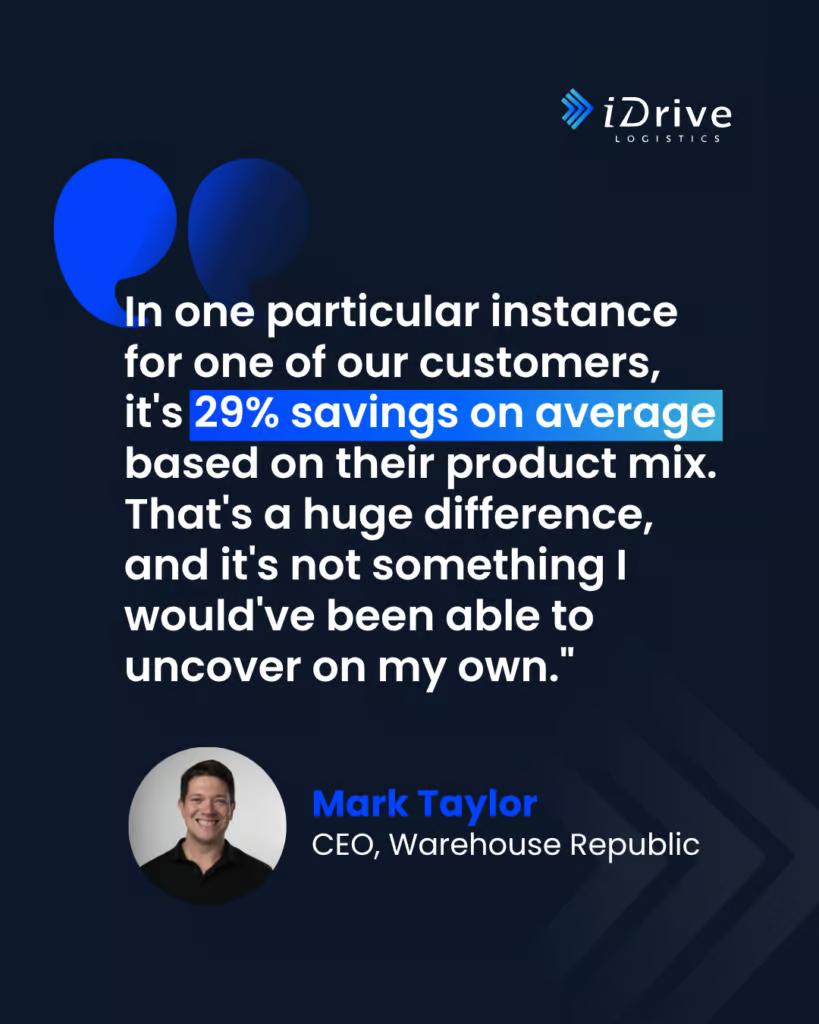
“I know in one particular instance, for one of our customers, it’s 29 percent savings on average based on their product mix. That’s a huge difference. And it’s not something I would have been able to uncover on my own.” – Mark Taylor, Founder, Warehouse Republic
Those savings came from matching that customer’s parcel profile to the right carriers rather than from a blanket discount. It also came out of an analysis Warehouse Republic wouldn’t have run on their own, using carrier options they didn’t have access to.
A Partnership Built on Trust
Mark is direct about how the arrangement felt at the start.
“Going into partnership with [iDrive] was, of course, a leap of faith. And this is such an important part of everybody’s business… having spent at least the last couple of years working together, I think there’s a high degree of trust — and that’s not typical of all organizations.” – Mark Taylor, Founder, Warehouse Republic
The trust came from dealing with the same people every time, and from us telling him when we’re not the right answer.
“I generally have felt iDrive really does work to do the right thing… [They’ve] been very clear: if [they’re] not the best option for something, [they’ve] said, ‘You probably need to do this or that.’…Being able to, from my own experience, tell other people that if it doesn’t work out, it’s not going to be because you’re working with bad people.” – Mark Taylor, Founder, Warehouse Republic
Telling a customer we’re not the right answer for a shipment costs us that shipment. It also lets a 3PL put our rate card in front of its own customers and stand behind it.
“My favorite thing is working with the people, and it’s all up and down the chain… I do feel like iDrive is a true partnership. And I think that when we’re doing well, iDrive’s doing well, and vice versa.” – Mark Taylor, Founder, Warehouse Republic
Mark’s message to other operators
“To my friends who run their own fulfillment and that kind of thing, I think there’s a lot of value in being able to know that you’re getting the best rates across several different options. And having a back office team that’s only focused on your shipping and parcel spend — only focused on that — I think is really solid.” – Mark Taylor, Founder, Warehouse Republic
He’s specific about who benefits most: operators with real volume who aren’t confident they negotiated well. His reasoning points at something most rate-card comparisons leave out.
“I’ve looked at friends’ rate cards, and their rates on the surface look better than ours, but when you factor in the dimensional divisor and the fact that they ship bulky products, they’re nowhere close to our rates.” – Mark Taylor, Founder, Warehouse Republic
“There are so many nuances with shipping that a lot of people just look at the rate card itself, and the zone, and the poundage, and then completely leave out the dimensional divisor aspect of it. And I think almost everyone owes it to themselves to do an analysis.” – Mark Taylor, Founder, Warehouse Republic
A rate card can look strong and still lose money on bulky freight once the dimensional divisor is applied. Comparing discounts off list won’t show you that. Comparing landed cost against your own shipment history will.
Run Your Own Numbers
If you’re a 3PL reselling shipping, your biggest cost line is probably the one with the least dedicated expertise behind it. That’s usually not neglect. The work spans several roles, and no single one of them justifies a hire at most operators’ volume.
We’ll rate-shop your recent shipping history against our carrier contracts on landed cost, and show you the difference shipment by shipment. If the answer is that you’ve already negotiated well, we’ll tell you that.
“It takes five minutes to pull your data.” – Mark Taylor, Founder, Warehouse Republic
Get in touch with iDrive Logistics to run a shipping analysis on your last 30 days of activity.
Related Case Studies
-

 Case Study
Feb 05, 2026
Case Study
Feb 05, 2026
How one 3PL grew their shipping margins by 5,890% over 5 years by partnering with iDrive Logistics
Read moreLearn how 3PLs can turn strategic shipping into an additional revenue stream.
-
 Case Study
Mar 21, 2025
Case Study
Mar 21, 2025
Food and Beverage
Read moreLearn how iDrive Logistics helped a food and beverage company get cost relief right before Q4.