
 Shipping
 Jun 30, 2026
Managed multi-carrier shipping: How rate-shopping across 12+ carriers actually works
Multi-carrier rate shopping sounds like a lookup — get the cheapest rate, print the label. In practice it’s a per-shipment optimization across cost, speed, zone, weight, dimensional weight, surcharges, business rules, and carrier capacity. Done well, it shifts an average of 21% off a brand’s annual shipping spend. This article opens up the engine —...
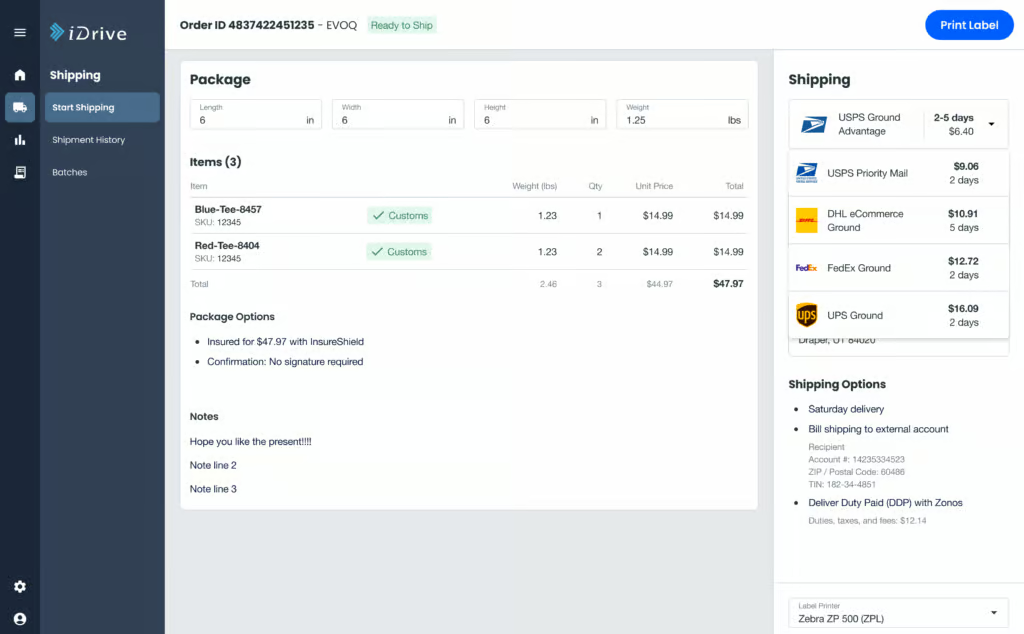
Multi-carrier rate shopping sounds like a lookup — get the cheapest rate, print the label. In practice it’s a per-shipment optimization across cost, speed, zone, weight, dimensional weight, surcharges, business rules, and carrier capacity.
Done well, it shifts an average of 21% off a brand’s annual shipping spend. This article opens up the engine — what carriers are in the network, what inputs the engine considers, what happens at label print, and what “managed” adds on top of running it yourself.
For the buyer-guide version, see our managed shipping guide; for the front-door definition, see what is managed shipping.
The carriers in the network
iDrive operates 12+ direct carrier contracts. Every carrier has a niche; the optimization engine knows which one matches each shipment.
Domestic nationals
- UPS — every zone and service level; best for B2B commercial accounts and time-definite delivery
- FedEx — 7-day delivery via Home Delivery; Ground Economy for cost-effective lightweight residential
- USPS — only carrier reaching every US address including PO boxes and APO/FPO; primary option for HAZMAT
- Amazon Shipping — 3.4-day average nationwide transit, less than 0.1% claims rate, 7-day delivery, no weekend surcharge
- DHL eCommerce — 19 US distribution centers, processes up to 50,000 pieces per hour; high-volume parcel where per-unit cost is the priority
Regional carriers
- OnTrac — 35 states, 70%+ US population coverage; transcontinental network with 7-day delivery to 75% of service area
- SpeedX — 12,000+ ZIP codes (~80% US population), 1M+ parcels daily, 95%+ on-time delivery rate
- GLS — Western states; no DIM weight on packages under 3 cu ft (significant for apparel and lightweight goods); often a full day faster than nationals over 150 miles on the West Coast
- DoorDash / DashLink — 12,000 ZIP codes, dense metro and suburban; same-day and scheduled delivery
- OSM Worldwide — nationwide via USPS last mile; certified carbon neutral
International
- iDrive holds direct international carrier contracts across UPS, FedEx, USPS, DHL eCommerce, DHL Express, and ePost Global, with DDP and DDU options where the lane supports it
- FlavorCloud (partner) covers 220+ countries through 300+ carriers with 99%+ customs automation
- Swap Commerce (partner) covers 220+ countries with DDP checkout, compliance automation, and global returns
The point of listing all of those isn’t comprehensiveness for its own sake — it’s that the optimization engine has more than a dozen moves to make on every shipment. Single-carrier shippers don’t have that.
The inputs the engine considers
For every shipment, the rate-shopping engine looks at:
- Origin and destination zones — there are eight US ground zones, plus international
- Weight and dimensions — including dimensional weight (DIM) implications and how each carrier calculates DIM
- Service-level requirement — next-day, 2-day, ground, economy
- Business rules — hard rules (carrier exclusions for hazmat-adjacent SKUs, brand requirements) and soft rules (preferred ranking, allocation targets)
- Carrier capacity and recent performance — has a carrier hit its capacity cap this week? Has on-time performance dropped on a specific lane?
- Current surcharges — peak surcharges, fuel surcharges, residential surcharges, oversize, address correction, large-package — all of which change quarterly
That’s the input vector. The output is one carrier and one service level, picked in the time it takes to print a label.
How the optimization runs (in plain language)
Four steps, executed per shipment.
- Rate calls. The TMS pulls real-time rates from each eligible carrier for the specific shipment.
- True-cost normalization. Surcharges, DIM adjustments, peak fees, and zone-specific add-ons get layered onto the base rate so you’re comparing true cost against true cost — not list rate against list rate.
- Business-rule overlay. Hard rules apply first (e.g., “USPS only for HAZMAT,” “no DoorDash for B2B”). Soft rules apply second (preferred ranking, regional allocation targets).
- Selection. The engine picks the lowest true-cost carrier that meets the service-level requirement, prints the label, and writes the decision to the audit log so you can see why.
The label format is standard 4×6 with the carrier’s tracking barcode. Your warehouse team’s SOP doesn’t change — they pick, pack, and print like they always have.
What “managed” adds vs. running it yourself
The most common buyer question: “I could just buy a multi-carrier TMS and run this myself, right?” Yes — and many brands do, until the operational tax catches up.
| If you run it yourself with a self-serve TMS | If you use a managed shipping partner |
|---|---|
| You configure the rules | Partner configures and tunes the rules continuously |
| You add new carrier integrations as needed | Partner already has 12+ live, with direct contracts |
| You audit invoices yourself, or you don’t | 47-point audit recovers $250K+/yr for many clients at scale |
| You file claims | Partner files claims |
| You absorb GRI annually | Partner models impact and reprices proactively |
| Carrier rates = whatever you negotiated | Partner-owned at $5B aggregated volume |
The choice isn’t “engine or no engine.” It’s “engine with you operating it” or “engine with a team operating it.” For the deeper version of that decision, see managed shipping vs. TMS.
Where rate-shopping pays off most
The engine has the most headroom when:
- Your zone variance is high — coast-to-coast shippers benefit more than single-region shippers
- Your package mix is mixed — some apparel (DIM-weight risk), some heavy (different optimal carrier)
- You hit carrier capacity caps during peak — diversification is its own value
- Service-level reliability matters — subscription brands, perishables, time-sensitive use cases
These are also the brands where the carrier mix savings tend to clear 20%, not 10%.
Where it pays off less
Honest version:
- Single-zone shippers — limited optimization headroom
- Brands committed to a single national carrier for brand reasons
- Sub-25K parcel/month volumes — the savings ceiling is too tight
If those describe you, run the engine yourself or stay on a self-serve platform.
A small worked example
Please note this is for illustrative purposes, with no customer rates shown.
A 2 lb apparel package shipping residential, Zone 5, no special handling. Three eligible carriers come back with quotes:
- National Carrier A — $X.XX base + DIM + residential surcharge + fuel = $A.AA true cost, 3-day transit
- Regional Carrier B (in-zone) — $X.XX base, no DIM (under 3 cu ft policy), no residential surcharge = $B.BB true cost, 2-day transit
- National Carrier C — $X.XX base + smaller DIM + no residential surcharge for the day = $C.CC true cost, 4-day transit
The engine picks Regional Carrier B: lowest true cost *and* faster transit. The label prints, the warehouse ships it, and the audit log records the decision.
The illustrative point: the carrier with the lowest list price often isn’t the lowest true cost once surcharges and DIM are normalized. Single-carrier shippers don’t see this comparison; they just pay whatever their one carrier charged.
How it integrates with your existing stack
The engine sits behind your existing tools — what most buyers eventually call a multi-carrier platform or a parcel TMS (the underlying Transportation Management System (TMS) layer).
- Your WMS or OMS continues to be the order-management interface
- Real-time sync — no batch exports
- Ultra-fast label printing for high-volume operations
- A single consolidated invoice from the managed partner replaces multiple carrier invoices
- Package-level detail (PLD) reporting flows into the carrier portal
- The same engine is sometimes referred to as rate shopping or carrier orchestration — those terms describe pieces of the workflow described above
For the related GRI mechanics — how the engine absorbs annual rate increases by shifting volume — see how managed shipping absorbs GRI increases.
Next step
If you want to see what the engine would pick on your actual shipments, the fastest way is to run a shipping analysis on your trailing 12 months. We surface where the engine would have rerouted volume, what cartonization changes would have done, and what audit credits you’d have recovered.
Related articles
-
 Shipping
Aug 12, 2024
Shipping
Aug 12, 2024
4 Must-Ask Questions When Negotiating Your Carrier Agreement
Read moreNegotiating a carrier agreement is a highly nuanced, complex process; but for businesses spending a large amount (> $100,000/year) on shipping, negotiating agreements becomes crucial for efficient and economical shipping.
-
 Shipping
Sep 30, 2024
Shipping
Sep 30, 2024
Diving Into General Rate Increases (GRI): What They Are and What They Really Mean
Read moreIt’s that time of year when shippers are beginning to see the effects of General Rate Increases (GRI). This year, both FedEx and UPS are raising their rates by 5.9%, both of which increases are now in force.
-
 Shipping
Mar 31, 2025
Shipping
Mar 31, 2025
Rate Shopping: How to Balance Cost and Quality in Your Shipping Decisions
Read moreIf you’re involved with shipping products you’ve probably heard the term ‘rate shopping’. Rate shopping refers to comparing rates of different carriers to select the cheapest service, but what if shippers were thinking about it all wrong?