
 iDrive Updates
 Nov 13, 2025
Supply Chain Shocks Are Constant: Can Your Logistics Tech Keep Up?
Rigid integrations keep shippers from adapting to constant disruption — but with flexible infrastructure, those same challenges can become opportunities to improve speed and resilience.
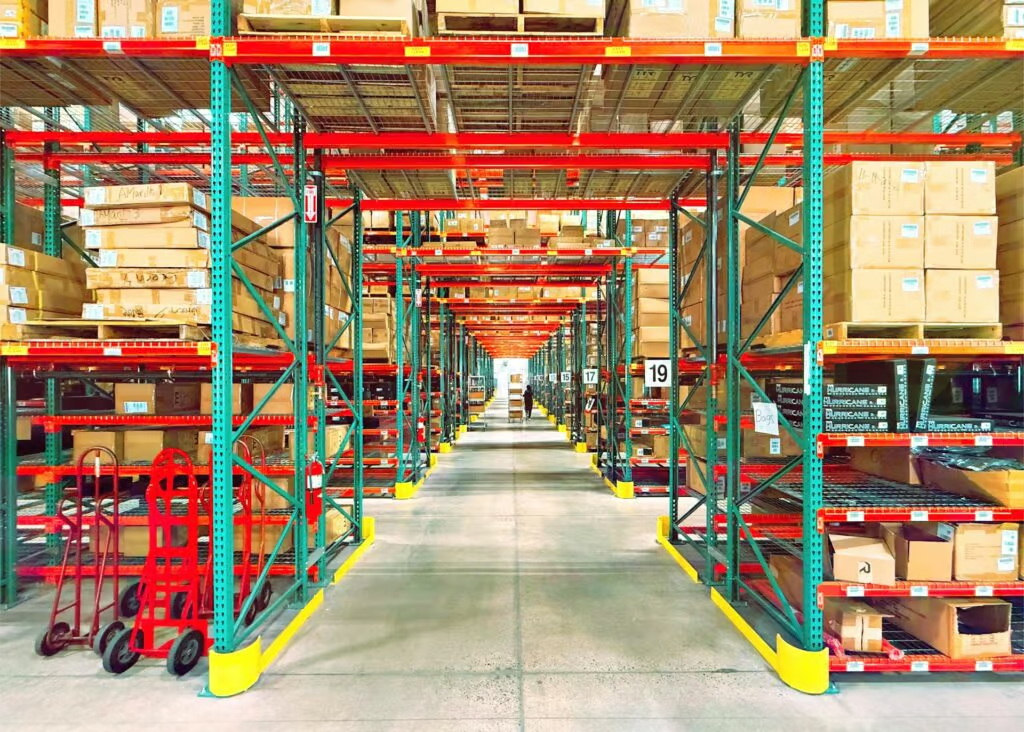
Supply chains no longer move in steady waters. Tariffs, pandemics, canal blockages, labor disputes, even infrastructure failures — major disruptions now arrive with unsettling regularity. For shippers, the challenge isn’t surviving a rare shock, but keeping pace with the rhythm of change.
In Episode 29 of Parcel Perspectives, Trackstar Co-founder Jeremy Schneck joined host Glenn Gooding to discuss why so many logistics tech stacks struggle to evolve — and what practical steps shippers can take to build resilience.
Here are the key takeaways, distilled into practical guidance for brands navigating this unpredictable market.
Disruption Is Relentless
For many years, brands operated under the assumption that their supply chains were stable — vulnerable only to the rare “black swan” event.
But that assumption no longer holds. Today, disruptions are predictable in their frequency, if not their form.
Every few months, something new alters the landscape. And for shippers, the question isn’t if a disruption will occur, but how fast they can adjust when it does.
This shift has raised the stakes for technology. Annual planning cycles and static tech stacks aren’t built for a world where priorities can be rewritten overnight. Without systems that can adapt on demand, businesses risk lagging behind each disruption—losing margin and speed, and leaving them exposed at exactly the wrong moments.
The Integration Gap
This is where many businesses fall behind. As companies grow — adding 3PLs, expanding into retail, or launching new channels — their tech stacks often remain locked in a past version of the business. The result is a widening gap between what the business needs and what its systems can deliver.
That gap creates two critical problems:
- Cost and time drain. One-off WMS integrations consume weeks of engineering, eating resources that could fuel innovation elsewhere.
- Customers experience failures. Without direct connectivity, even simple order changes can spiral into days of back-and-forth. With integration, the same change is confirmed in seconds.
Schneck illustrated this with a simple example: a customer ordering the wrong color T-shirt.
Without WMS connectivity, the change request can bounce between chatbots, customer service, brand staff, and warehouses for a week before resolution. With direct integration, the same request is validated and updated in under a minute.
Clearly, integration gaps don’t simply create inefficiency. The longer they persist, the more they erode both margin and customer trust.
Not the Shipper’s Burden
But shippers shouldn’t be expected to carry this burden alone — an important point shared by Schneck on the podcast.
Their role is to set priorities — which workflows matter most to their customers and their margins. The role of logistics partners and technology providers is to make sure systems can deliver on those priorities.
Too often, brands are forced to play systems integrator when they should be focused on growth and customer experience.
That point is quite easy to support. Integration is plumbing; it belongs with partners who can manage it at scale.
Flexibility in a Growing Ecosystem
The question now becomes: what kinds of solutions support adaptability?
Some companies use “connect once” frameworks to simplify onboarding. Others rely on middleware to manage complexity across multiple systems, while some build targeted connections where performance demands it.
The approach will vary depending on your WMS, your 3PL network, and your internal resources. What matters is designing for flexibility — ensuring your stack can evolve as your business does.
And the urgency is increasing. Supply chain technology is expanding rapidly, with new tools emerging every month. Shippers that remain locked into rigid integrations risk missing opportunities to tap into these innovations. Those that prioritize flexibility position themselves to move faster and adapt with less friction.
What Shippers Can Do
Addressing the integration gap doesn’t have to mean a massive overhaul. Brands can take immediate steps to create momentum:
- Map the pain. Identify where current integrations slow you down or drain resources.
- Focus on one high-impact workflow. Start with a customer-facing process like order edits or returns.
- Engage partners. Work with your WMS, 3PLs, and advisors to decide which integration approach makes sense for that workflow.
- Measure outcomes. Track improvements in speed, cost, and customer response.
- Expand gradually. Apply what works to the next priority area.
These steps also create proof points for the organization. For example, turning a week-long order edit into a 30-second workflow doesn’t just improve customer experience, but also proves the value of investing in connectivity.
Wrapping Up
In the end, disruptions can slow you down, and when they happen as often as they now do, you must have a solid plan for weathering whatever comes. Otherwise, your business can take a hit.
For many shippers, the hidden drag comes from outdated integrations that waste resources and frustrate customers. With the right focus, you can position yourself not just to survive the next disruption, but to capture margin and loyalty their competitors leave behind.
Need help identifying where integrations are slowing you down? Talk to iDrive Logistics.
Related articles
-
 iDrive Updates
Dec 06, 2024
iDrive Updates
Dec 06, 2024
Enhancing Customer Loyalty Through Exceptional Shipping Experiences
Read moreHow Shipping Insurance Can Help SMBs Compete in the Age of E-commerce
-
 iDrive Updates
Dec 04, 2024
iDrive Updates
Dec 04, 2024
Navigating the Complex Waters of Parcel Sourcing Strategies
Read moreInsights from Episode 8 of "Parcel Perspectives"
-
 iDrive Updates
Nov 27, 2024
iDrive Updates
Nov 27, 2024
Navigating the Peaks and Valleys of Reverse Logistics for Holiday eCommerce
Read moreReturns are ian opportunity for businesses to optimize operations, build brand loyalty, and embrace sustainability in a meaningful way.