
 iDrive Updates
 Aug 08, 2025
What Happens When Amazon Delivers More Than FedEx?
With volume shifting to Amazon and new providers, the rules of carrier access and leverage are changing. Here’s how shippers can adapt before they get boxed out.
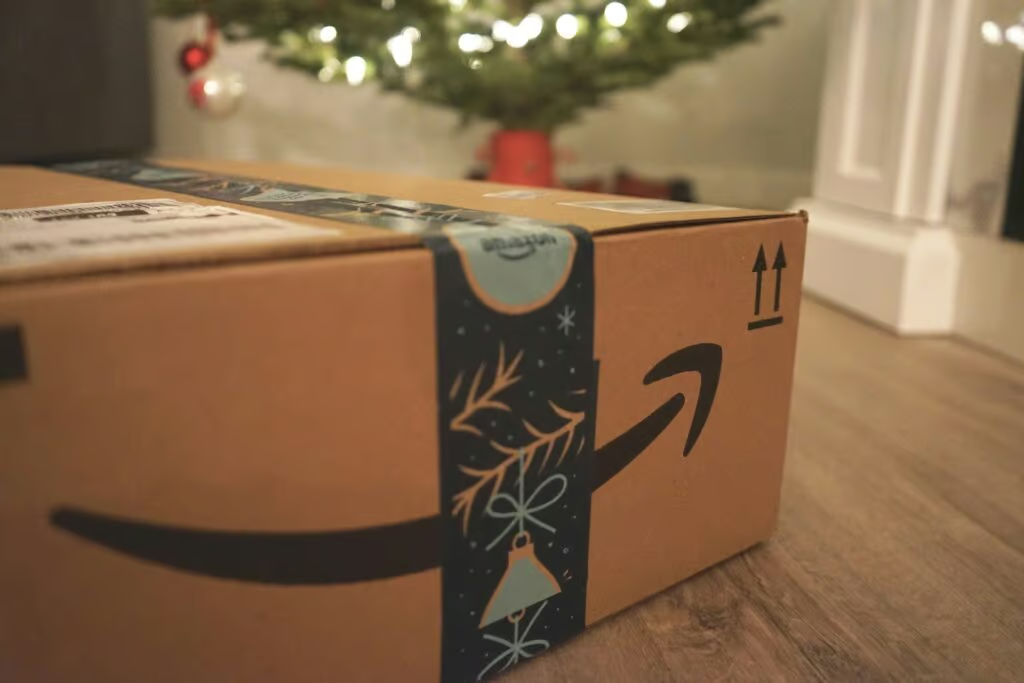
Amazon Logistics now accounts for 25% of daily U.S. parcel volume—surpassing FedEx and UPS, and trailing only USPS. That stat, based on ShipMatrix data, reflects a major transformation in how goods move across the country. But it’s not just a headline—it’s a signal that the entire carrier landscape is realigning.
In Episode 24 of Parcel Perspectives, iDrive Logistics President Glenn Gooding breaks down how legacy carriers are responding to this shift and how shippers can stay competitive as the market fragments.
Retailer-Driven Growth, Carrier Fragmentation
From 2019 to 2024, total parcel volume in the U.S. has continued to grow. But that growth isn’t spread evenly. Amazon, Walmart, and Target are driving much of the increase by internalizing their delivery operations. Amazon alone now delivers 1 in every 4 parcels in the U.S., according to ShipMatrix.
While Amazon’s residential network is highly capable—with seven-day service, door-to-door delivery, and visual proof of delivery—it isn’t a one-size-fits-all solution. The network still excludes PO boxes, doesn’t offer air or express options, and has limited pickup coverage for many origin points.
The rest of the market, especially regional and gig-economy carriers, is catching some of the spillover. These “Others” now represent a growing slice of volume, especially in dense metro areas and for lightweight parcels.
Legacy Carriers Feel the Pressure
As more volume moves to Amazon and Others, the traditional “Big 3”—UPS, FedEx, and USPS—are being left with a shrinking share. In response, they’ve doubled down on revenue protection measures that are making it harder for many shippers to operate efficiently.
Current market behavior includes stricter contract terms and volume commitments, increased surcharges (fuel, peak, address corrections), and less flexibility for low-volume or inconsistent shippers.
These structural shifts are especially painful for SMBs, who may not meet thresholds for discounts or account support—and who often lack the leverage to renegotiate on favorable terms.
Carrier Access Is Narrowing
At the same time, access to fast-growing alternatives isn’t always guaranteed. Many regional and gig carriers require volume aggregation or specific platform integrations, putting them out of reach for smaller brands. While the market offers more options, those options aren’t equally available to everyone.
This growing divide is reshaping how shippers evaluate their carrier mix—and who they can realistically ship with as national players pull back support.
3PLs Are Becoming a Strategic Lever
For shippers trying to reach beyond the legacy networks or gain efficiencies across multiple carriers, third-party logistics providers (3PLs) are increasingly critical. A strong 3PL partner can:
- Aggregate volume across clients to unlock better rates
- Open access to regionals and gig carriers
- Improve cost profiles with better pickup density and routing
- Provide operational flexibility in a fragmented network
For SMBs in particular, a 3PL can bridge the access gap and restore leverage at a time when individual shippers are being pushed to the sidelines.
What to Consider When Restructuring Your Carrier Strategy
As the market shifts, shippers need to take a closer look at how their parcel volume is distributed—and who they rely on to move it.
Here’s where to focus:
- Segment your volume by weight, zone, and urgency to understand where alternatives make sense
- Audit carrier contracts to identify inflexibility and hidden cost drivers
- Diversify carriers to match different shipment profiles with different strengths
- Leverage a 3PL to expand access and improve cost efficiency without sacrificing service
Each of these steps reflects the episode’s core message: the shipping environment has changed, and strategy needs to evolve with it.
Carrier consolidation is no longer the norm. Today’s shipping environment demands adaptability, diversified routing, and smarter partnerships. Whether you’re feeling squeezed by rising fees or unsure how to access new carrier networks, now is the time to evaluate your parcel strategy—before constraints tighten further.
Need help evaluating your options? Contact iDrive Logistics to start building a smarter parcel strategy.
Related articles
-
 iDrive Updates
Dec 06, 2024
iDrive Updates
Dec 06, 2024
Enhancing Customer Loyalty Through Exceptional Shipping Experiences
Read moreHow Shipping Insurance Can Help SMBs Compete in the Age of E-commerce
-
 iDrive Updates
Dec 04, 2024
iDrive Updates
Dec 04, 2024
Navigating the Complex Waters of Parcel Sourcing Strategies
Read moreInsights from Episode 8 of "Parcel Perspectives"
-
 iDrive Updates
Nov 27, 2024
iDrive Updates
Nov 27, 2024
Navigating the Peaks and Valleys of Reverse Logistics for Holiday eCommerce
Read moreReturns are ian opportunity for businesses to optimize operations, build brand loyalty, and embrace sustainability in a meaningful way.