
 iDrive Partners
 Jul 13, 2026
The Importance of Carrier Rates in Your WMS
When WMS rate shopping happens inside the pack-and-ship workflow, margin stops leaking between systems. Here's what it takes to close that seam.
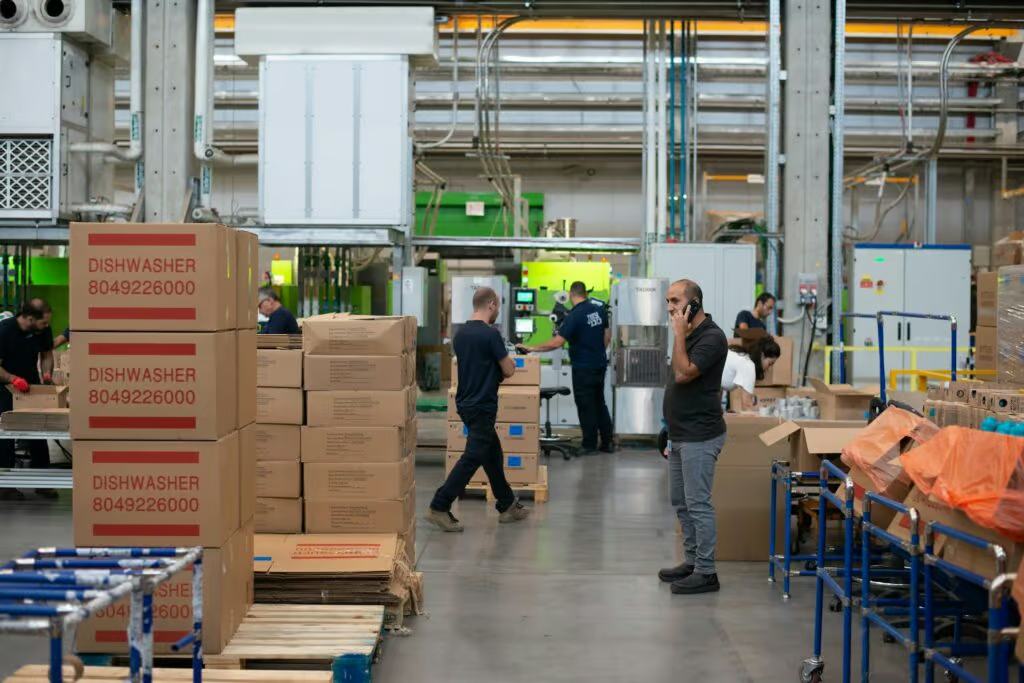
This is a guest post from the Extensiv team.
Sellers may not be used to seeing carrier rates in their warehouse management systems, but it’s important enough that we’ve prioritized it in the Extensiv Small Parcel Suite.
You rarely lose margin on one bad shipping decision. Instead, we see sellers suffering in small, ordinary moments: a packer defaults to the usual carrier because the line is backing up, a cheaper service shows up after the label is printed, or someone skips a manual rate check because there are 200 more orders waiting.
These small, seemingly innocuous decisions add up across thousands of shipments, and sellers don’t have a lot of visibility into how carrier decisions are made.
That opacity comes from a disconnect between your WMS and shipping rates, and for 3PLs it’s where margin leakage comes from. In this article, we’ll talk about the hidden costs of keeping your WMS and shipping rate decisions siloed, and how we fixed the issue with iDrive Logistics.
The Hidden Cost of Disconnected Shipping Decisions
No single shipment looks like the problem. That is what makes the leak easy to miss.
A few extra cents here. A missed cheaper service there. A surcharge nobody caught until after the label printed. Across hundreds or thousands of shipments, those small misses become real money. On average, iDrive’s multi-carrier diversification approach can save a 3PL 21% on shipping costs.
The cost usually shows up in three ways.
1) Margin Leakage
Carrier pricing changes constantly. Rates vary by zone, weight, dimensions, service level, and accessorial charges. The best option for one package is rarely the best option for the next.
When rate shopping happens outside the shipping workflow, the lowest-cost valid option often surfaces too late. Once the label is printed, the opportunity is gone.
The result is not one expensive shipment. It is thousands of small missed opportunities that slowly leak revenue.
2) Time Leakage
Manual rate shopping does not scale. At lower volumes, checking rates across multiple carriers feels manageable. As volume grows, it becomes impossible to sustain. Teams naturally prioritize throughput over optimization because they have orders to get out the door.
Eventually, the team defaults to a preferred carrier or service simply because it is faster.
3) Error Leakage
Every manual handoff creates another opportunity for mistakes. Shipment information gets re-entered. Rate tables become outdated. Surcharges are overlooked. Service selections are made without complete information.
When fulfillment data and carrier intelligence live in separate systems, your team becomes responsible for connecting them. No amount of diligence can fully eliminate the risk that creates.
What Effective WMS Rate Shopping Actually Requires
Real rate shopping goes beyond comparing carrier prices.
To protect margin consistently, three things need to happen.
1) Carrier Intelligence Must Be Current
Static rate tables start aging the moment carriers update pricing.
Effective carrier rate comparison requires access to live rates, service levels, transit times, and surcharges across multiple carriers.
2) The Information Must Appear at the Moment of Decision
Finding a better rate after the shipment leaves the building does not help.
The most important moment is when the label is created. That is when the decision affects cost.
Any system that delivers insight before or after that moment misses the opportunity to create value.
3) It Cannot Add Extra Work
If employees have to leave their workflow, open another system, compare options, and return to complete the shipment, adoption eventually breaks down.
Warehouse teams move fast. The difference between having rate data and actually using it is a tool that provides recommendations within the system itself.
The WMS Is the System of Record, but Rate Intelligence Makes It Smarter
Every shipment requires two distinct capabilities.
The first is operational execution. Your warehouse management system owns the order, inventory, picking, packing, shipping, and fulfillment workflow. It is the system of record that keeps the operation moving.
The second is shipping intelligence. This layer determines which carrier and service should be used to move the package at the lowest defensible cost.
For many 3PLs, those functions have traditionally lived in separate systems. But, the fulfillment workflow and the shipping decision are part of the same process. Separating them creates friction, where connecting them creates efficiency.
Closing the Seam Between Fulfillment and Freight
That is exactly what happens when carrier rate intelligence is embedded directly into the shipping workflow.
With iDrive Logistics transportation services available inside Extensiv Small Parcel Suite, carrier options and rates surface where warehouse teams are already packing and shipping orders. Teams can compare services and select the most cost-effective option without leaving the workflow.
“Our integration with Extensiv enables 3PLs to run shipping as a profit center, adding as much as 10% net margin to the existing bottom line. We do this by providing the staff and services that reduce 3PLs operational costs while at the same time reducing their shipping costs and increasing margin. It’s really the best of both worlds (Tech and Shipping) for a 3PL… they get the efficient WMS software solution as well as a robust multi-carrier shipping solution natively integrated into their primary platform,” says Rachel Go, CMO at iDrive Logistics.
The process becomes one action instead of two. The best available option is presented before the label is printed.
What Changes Operationally?
The margin leak closes because better rates are identified before shipping costs are committed.
The time leak closes because employees stay inside a single workflow.
The error leak closes because information does not have to be transferred between systems.
Most importantly, savings become systematic instead of situational.
The operation no longer depends on whether someone had enough time to compare rates.
Where Rate Shopping Belongs
The question is not whether your operation is rate shopping. You are probably doing some version of it already. The more important question is where it happens.
If rate shopping lives beside the shipping workflow, savings can still slip away before they are captured.
If rate shopping lives inside the workflow, every shipment becomes an opportunity to protect margin automatically.
For 3PLs operating in a business where every percentage point matters, that distinction can have a meaningful impact. With iDrive integrated into Extensiv Small Parcel Suite, fulfillment and freight finally work together at the exact moment where cost decisions are made, before the label prints.
Ready to Close the Gap?
Extensiv Small Parcel Suite combines fulfillment execution with built-in shipping optimization, helping 3PLs reduce shipping costs, improve efficiency, and protect margin on every order.
See how Extensiv and iDrive Logistics helps 3PLs ship smarter without slowing down operations.
Want to get started on Extensiv? Reach out here.
Frequently asked questions
What is WMS rate shopping?
WMS rate shopping is the practice of comparing live carrier rates and selecting the most cost-effective option inside the warehouse management system, at the moment an order is packed and shipped. The decision happens where fulfillment occurs, so the best rate is applied before the label prints.
Why does rate shopping inside the WMS matter more than a separate tool?
Carrier savings have a short shelf life. A better rate that surfaces after the label prints is a rate you never captured. When rate comparison happens inside the pack-and-ship workflow, the cheapest valid option becomes the default for every order, instead of something the team catches only when there is time to check by hand.
How does carrier rate comparison reduce small parcel shipping costs?
Carrier pricing varies by service, zone, weight, and surcharge, so the cheapest carrier changes order to order. Comparing real rates per shipment captures the lowest defensible cost on each label, and across thousands of orders those differences add up.
Does connecting a WMS and a rate-shopping engine add steps for the team?
It should remove them. A well-built integration surfaces carrier rates inside the existing pack-and-ship screen, so there is no separate portal and no re-keying. If a rate tool asks the team to leave their system and come back, the friction usually cancels out the savings.
What is the difference between the fulfillment system of record and the pricing intelligence layer?
The system of record, such as Extensiv Small Parcel Suite, owns the order and the pack-and-ship workflow. The pricing intelligence layer, such as iDrive, owns live carrier rates and decides which label protects margin. They do separate jobs, and connecting them turns two manual steps into one motion.
Related articles
-
 iDrive Partners
Sep 12, 2025
iDrive Partners
Sep 12, 2025
Why Dropship Automation Matters in a Parcel-Centric Logistics Strategy
Read moreFor eCommerce businesses, particularly those in industries like firearms, automotive, or apparel, dropshipping offers a way to scale without the burden of holding inventory.