 27
27
 Sep 03, 2025
 19:19
19:19
The Complexity of Carrier Surcharges – What Shippers Need to Know
Carrier surcharges are more complex than ever, with UPS, FedEx, and USPS using fees like fuel, delivery area, and additional handling to recover margin. In this episode of Parcel Perspectives, Glenn Gooding explains how these shifting charges impact shippers and shares practical steps—like audits, analytics, and multi-carrier strategies—to control costs. The takeaway: focus on total landed cost, not just base rates.


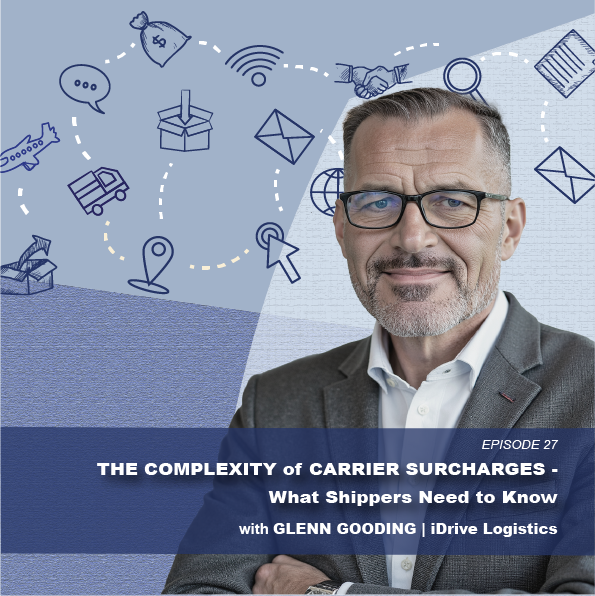
In this episode of Parcel Perspectives, Glenn Gooding breaks down the surcharge puzzle and why it matters more than ever for shippers. What began as reasonable fees for fuel or residential delivery have turned into shifting rules and constant increases, with carriers using them to make back lost margin.
Listeners will learn:
- Why surcharges such as fuel, delivery area, and additional handling keep changing
- How carriers “claw back” margin despite discounts
- The compounding effect of rising fuel surcharges
- Practical steps: invoice audits, analytics, and multi-carrier strategies
- How tech platforms and 3PLs can unlock new delivery options
Glenn’s key message is simple: visibility and collaboration are essential, and the smartest shippers focus on total landed cost, and not just base rates.
[00:00:00] As you can see, both carriers have viewed this as an opportunity to grow revenue, not grow volume necessarily, but grow revenue, and they’ve manipulated these charges over time. Every single surcharge that you see has been manipulated over time. Delivery area surcharge, zip codes, get reassigned on a quarterly basis. Then, they brought up extended delivery area surcharge, and then, remember the advent of remote area surcharge? Constantly being manipulated.
[00:00:37] Welcome to Parcel Perspectives, the podcast dedicated to small parcel shippers. I’m Glenn Gooding. In each episode, we dive into insights, best practices, and strategies to help you navigate this complex and costly market.
[00:00:51] Hello, everyone. This is Glenn Gooding with Parcel Perspectives. Welcome to another episode. Today, I’d like to dive in just a little bit on the complexity of carrier surcharges and what shippers need to know.
[00:01:04] Fuel, residential surcharges, delivery area surcharges, demand surcharges, additional handling – the list goes on and on and on. What makes these surcharges so frustrating to the average shipper is that they’re rarely transparent. They can be inconsistently applied, and they’re constantly changing. For example, UPS and FedEx have modified their fuel surcharge table 14 times in the last three and a half years – 14 times.
[00:01:42] For many shippers, these hidden fees make up a growing percentage of their shipping spend, and they rarely show up when you’re sitting at the negotiating table. So, I think the fundamental question is: What can you do about it? So I’m going to try to break down some of the major surcharge types, how they’ve evolved, and what you can do to identify and reduce these costs in your shipping operation.
[00:02:10] Let’s try to jump in. So, when I sit down with a shipper and we talk about their expense, I break their spend level in the small parcel world into two primary buckets, and depending on the carrier, a third bucket primarily.
[00:02:26] One is base transportation. Base transportation is a fairly easy animal to understand. You pick the mode, ground, today, overnight – you name it, and there’s a subsequent rate card. That rate card is broken out zonally and weight based from one pound all the way up to 150 pounds. And you can apply a discount to that. Now, most shippers, I would say that kind of charge, that transportation charge, accounts for somewhere between 60 and 70% of what you’re paying a carrier.
[00:03:04] Now, the other bucket would be surcharges and accessorials. Those are oftentimes ambiguous, hard to understand, hard to quantify, and in an area that the carriers really manipulate a lot to their benefit.
[00:03:22] The third bucket, particularly if you’re billed from a traditional perspective via UPS, are shipping charge corrections.
[00:03:29] You manifested the package as a ground package at one pound and after going through the UPS hub operation and getting dimensionalized to find out that it dimensions at five pounds; therefore, there’s an adjustment – you’re going to pay the five pound rate instead of the one pound rate would be a great example of that kind of spend bucket.
[00:03:50] So one must ask first off: Why the surcharges? What’s going on there? Well, I think everything in the small parcel market starts with a foundation of logic and maybe a little bit of innocence. One would contend that a commercial delivery has a different cost structure than a residential delivery.
[00:04:13] Commercial deliveries usually travel with other parcels. If they’re not your parcels, there’s somebody else’s parcels going to that business on the same day. Therefore, you have a high number of packages being delivered at a commercial stop higher than a residential. Therefore, the revenue per stop is higher.
[00:04:28] Commercial deliveries are often clustered in dense areas, commercial parks, strip malls – malls, the things of that nature, so that from a stops-per-mile perspective, you have a high number of stops per mile. Residential market’s a little different animal. You’re going off into neighborhoods. You’re delivering on average one package per residential delivery, and that package is typically lighter than a commercial delivery. [As a matter of fact], the majority of residential deliveries weigh less than a pound or up to about nine or 10 pounds max. Of course, there’s exceptions, right? But the majority of the things you’re receiving on a day-to-day basis in a residential market fall in that area. The revenue on a five pound single package for a carrier is a much different animal than a 20 pound multi-piece delivery in a commercial environment.
[00:05:26] So UPS and FedEx looked at these differences. They looked at differences in zip codes and where people live, densities, and they first started to assign surcharges associated with some of these things that require additional service steps or an additional cost structure. I think the one most obvious one that pops up is a residential surcharge.
[00:05:49] Residential deliveries cost more to service. Therefore, it justifies a surcharge. Another one that pops up a lot are things like a weekly service fee. There’s an expense for the carrier to send a driver to your business on a weekly basis and make a pickup whether or not you ship packages or not.
[00:06:11] There’s an expense to maintain the account number and to run a billing site and to invoice you, right? So you have weekly service fees. You know, fuel. Well, back in the late 90s and the early 2000s, we had 9/11. We had military activity, we had an unstable fuel supply based off of global conflict.
[00:06:36] The carriers incurred a lot of additional expense due to rising fuel costs, so they imposed a fuel surcharge. So, the inception may always be rooted in logic. However, there’s a common rule or principle you need to apply in a small parcel world. Once a surcharge, once a billing methodology is pushed into the marketplace, it will not go away. It will metastasize, it will grow, it will be manipulated. I’ll give you another example. Additional handling is a great example. I don’t know if you, folks, realize it or not, but you know, UPS and FedEx have to process hundreds of thousands of parcels overnight, get stuff from point A to point B to move from pickup to delivery.
[00:07:26] Those are high production, high pressure operations where volume is moved via massive conveyor belts at tens of thousands of parcels per hour. If they aren’t able to achieve those productivity standards, they don’t get done and you have a service failure. Not all parcels can be moved on a conveyor belt safely, and that’s what really started additional handling as a surcharge.
[00:07:54] Things that are too long – a seven foot roll of carpet probably not going to make a 90 degree turn in a conveyed environment. It’s probably going to cause a jam. And a number of packages are going to get damaged. Some may fall off the conveyor and hit the floor several feet down below and be damaged again, and could hurt someone.
[00:08:13] Great example of an additional handling qualifying package. Package is not encased in corrugated cardboard. Imagine a bare metal muffler, a trader hitch, a set of rims for a car, tires, five gallon bucket of liquid, a 25 quart cooler filled with lab samples, okay? And dry ice. These things can’t move safely on a conveyor belt.
[00:08:48] They’re going to cut the equipment, they’re going to damage other parcels, they’re going to hurt employees. A packet is that way over 70 pounds. You don’t want to bowl for people when those things come rolling down. A gravity feed shoot into a trailer, it’s going to create carnage. So, all of these parcels are moved more manually through a parcel operation.
[00:09:12] Those manual parcel operations do not process tens of thousands of parcels an hour. They can’t. And so, UPS and FedEx have a much higher cost associated with servicing those parcels, hence, the genesis of additional handling surcharge.
[00:09:13] Now, the reason I brought additional handling surcharge up for this example is, it’s been modified several times and it deviates from the logic I just talked about. For example, weight based. Over 70 pounds is a credible argument; 51 pounds is not a credible argument. I promise you, tour a carrier operation and challenge the operator not to process 51 pound pack boxes on the conveyor belt. They won’t get done. Yet, both carriers have redefined additional handling by weight, down to anything that weighs more than 50 pounds.
[00:10:09] Remember that seven foot roll of carpet I talked about? Prior to August 17th, that seven foot roll is now shrunk to a four foot roll, 48 inches. I promise you. Forty-eight inch packages move on the conveyor belt quite nicely. So, as you can see, both carriers have viewed this as an opportunity to grow revenue, not grow volume necessarily, but grow revenue, and they’ve manipulated these charges over time.
[00:10:42] Every single surcharge that you see has been manipulated over time. Delivery area surcharge, zip codes, get reassigned on a quarterly basis. Then, they brought up extended delivery area surcharge, and then, remember the advent of remote area surcharge? Constantly being manipulated.
[00:11:03] At the end of the day, the reason that these things happen is that folks like you are good business people. You’re skilled negotiators. You can look at a transportation rate, you can look at a rate card, you can look at a discount, and you can negotiate with a carrier and get improved discounts on those services.
[00:11:26] So, the carriers, the folks that hold the revenue managers, the ones that hold the purse strings for the carriers, have to placate you as a skilled negotiator. And then, they have to find a way to make back that margin through other methods. And the way they’ve chosen to employ that is by manipulating these surcharges – adding to it, changing the methodology, making the qualifying standards more liberal, or pushing increases that you don’t see or can’t understand, and so, a general rule will apply. You may have gotten an A+ in your last RFP event and you’ve awarded your volume to FedEx in 2024. Felt like you had market leading rates.
[00:12:15] I can assure you with great confidence that the margin for FedEx in 2024 is less than the margin for that same volume is in 2025. Why? The general rate increase and the manipulation and increases passed along through some of these very ambiguous surcharges. They will claw back their margin. They will give you what you’re asking for, and claw it back over time. Important to know.
[00:12:47] Now, when you think about the effect of these things, you have to understand that they have a compounding effect on your transportation expense. I’d mentioned that fuel has been adjusted 14 times in the last three and a half years.
[00:13:04] Additional handling has been adjusted umpteen times, generate increases, new definitions, mid-year increases, demand surcharges. All of those things also get impacted by fuel. So, what was an 8.25% fuel surcharge three and a half years ago is now in excess of a 19% fuel surcharge without a cost of fuel increase at the pump, and that fuel surcharge is applied to every accessorial and surcharge I’ve mentioned. So, on top of your 20% increase on additional handling in 2025, you can also enjoy increased fuel on top of that. How do you regain control? It’s tricky. Requires good analytics. And then once you have those good analytics, it requires someone that understands what it says, and how to navigate those waters.
[00:14:01] For starters, do a good, robust forensic audit of your previous three to six months of invoices for surcharge creep. Right now might be a great time to do that because a doozy is coming August 17th. And if you haven’t listened to it, you need to listen to my podcast on additional handling charges. Track your surcharge impact as a percentage of total shipping spend, and sit down and collaborate with the carriers you source with.
[00:14:33] Knowledge is power. If you don’t articulate your case, if you don’t base it in good analytics, empirical data, all you’re doing is holding your hand out, asking for more. So, have a good idea of where that is.
[00:14:39] Another great option, there are a lot of resources in this SMB space in today’s world. There are some fantastic tech platforms that offer great landed cost visibility. And multi-carrier solutions to allow you to rate, shop and compare between carriers and a desired customer experience. And 3PLs are growing and growing rapidly out there. If you’re an SMB, and you hear – you go to parcel forum and you hear a great presentation on the benefits of utilizing regional carriers, sounds great.
[00:15:34] But if you want to use a regional carrier that provides excellent service in the state of Texas, but you don’t have a distribution center in Texas, you, my friend, have a problem. You need to get volume into that carrier network. Those are challenges, right? If you look and say, wow, I’d love to use Amazon as a delivery provider right here, they’re growing and they are. Great. If you don’t have enough daily volume to justify the pickup, you’ve got to figure out a way to get it to Amazon.
[00:15:54] Oh, by the way, Amazon doesn’t provide pickup in every geography in the US. So, if you’re not in that geography, tough luck for now. So, 3PLs provide an opportunity. Good 3PLs provide an opportunity to bring and aggregate volume across a number of brands, and then, bring a portfolio of services to you, brands that you normally wouldn’t have.
[00:16:21] The traditional UPS, tried and true FedEx, USPS. But then you can bring in things like OnTrac/LaserShip. You could bring in gig economy solutions and UniUni, SpeedX, Veho, right? You could bring in an Amazon delivery. 3PLs that are robust and sophisticated with good tech platforms can bring a lot of solutions, a lot of visibility, a lot of tools into your logistics world, if you’re an SMB.
[00:16:59] If you’re large enough to go it alone and look at this, you need to deconstruct your existing legacy agreements with the UPSs and the FedExs of the world. Invariably, they have performance language or punitive language in there, to try to prevent you from multi-sourcing. You need to understand the implications, and you need to devise a choreographed strategy of how you’re going to go to market and potentially bring in another carrier without upsetting the applecart.
[00:17:29] So, key takeaways in this market? Visibility. Know what you’re paying, break it down by surcharge type. Force good collaborative partnerships with your carriers. Hold them accountable through QBRs.
[00:17:48] Choose your carriers based off of total net landed cost, not base rates alone. And ensure it aligns with your desired customer experience, and use a shipping cost analysis service – could be like the one that I offer here at iDrive. Use a tech platform that gives you visibility and an ability for multi-carrier solutions.
[00:18:14] Lean into a good, robust 3PL that can bring solutions you couldn’t obtain on your own. Hope you found this helpful. Thank you for tuning into another episode of Parcel Perspectives, and I hope to be a resource for you, whenever you need it. Take care.
[00:18:35] Thanks for listening to Parcel Perspectives hosted by me, Glen Gooding. I’ve been in the small parcel space for 37 years, starting with a deep and broad background, working for one of the major carriers as an operator and industrial engineer, later managing pricing at the highest level for the largest, most complex shippers in the world.
[00:18:53] Since then, I’ve been a national thought leader and worked to help drive strategy for clients from Fortune 50 companies to start up eCommerce businesses, helping them more competitively align in this complex and expensive market.
[00:19:06] If you enjoyed the show, please subscribe and share with friends. Join us next time for more expert advice and strategies to stay ahead of the shipping game.
Key Topics with Timestamps
- 1:04 Why surcharges matter
- 2:12 Breaking down parcel spend
- 3:50 The logic behind surcharges
- 6:44 The rule of surcharges
- 7:09 Additional handling explained
- 9:31 How definitions and fees shift
- 10:44 Delivery area manipulation
- 11:36 Margin clawbacks and short-term wins
- 12:15 Erosion of shipper margin
- 12:47 The compounding effect
- 14:01 Visibility, smarter partnerships, and key takeaways
Other Podcasts
-
10
Jan 22, 2025
A Consultant’s Role in Supply Chain & Carrier Contracts
Discover how logistics consultancy revolutionized small parcel shipping for Right Manufacturing Systems in this episode of Parcel Perspectives. Join Glenn Gooding and Ian Hartman as they discuss achieving a 23% reduction in shipping costs, leveraging data for smarter decisions, and the invaluable insights gained from expert consultancy. Tune in to learn how deep industry knowledge and strategic negotiations can transform your logistics operations.
-
9
Nov 13, 2024
How Reverse Logistics Shapes Holiday eCommerce
Join Glenn Gooding and Cathy Roberson as they dive into the world of reverse logistics. Discover how carriers like UPS, FedEx, and USPS are adapting to the growing returns trend, and explore innovative strategies for handling oversized items and complex returns. Learn about the latest trends, including "bracketing" and sustainable practices, and how AI is transforming the returns process.
-
15
Feb 19, 2025
Future Vision: Key Supply Chain Investments for the Next Decade
The Future of Logistics is Here. Join Glenn Gooding and special guest Benjamin Gordon, Managing Partner and CEO at Cambridge Capital, in this week's episode of Parcel Perspectives as they explore the cutting edge of supply chain management. This episode covers it all: the AI revolution, the eCommerce explosion, the crucial role of customer experience, and the growing importance of sustainability. Get expert insights into future investment opportunities and discover how to build a resilient supply chain that can withstand any disruption. Tune in and future-proof your business!