 29
29
 Oct 22, 2025
 31:52
31:52
From Bottlenecks to Breakthroughs: Building the Future of Logistics Tech Stacks
When legacy systems hold supply chains back, innovation suffers. In this episode, Glenn Gooding sits down with Trackstar Co-founder Jeremy Schneck to unpack how a universal API is changing that. From breaking through WMS bottlenecks to enabling seamless integrations across 3PLs, software providers, and shippers, Jeremy shares how Trackstar is helping the logistics industry move from disconnected tools to connected growth.


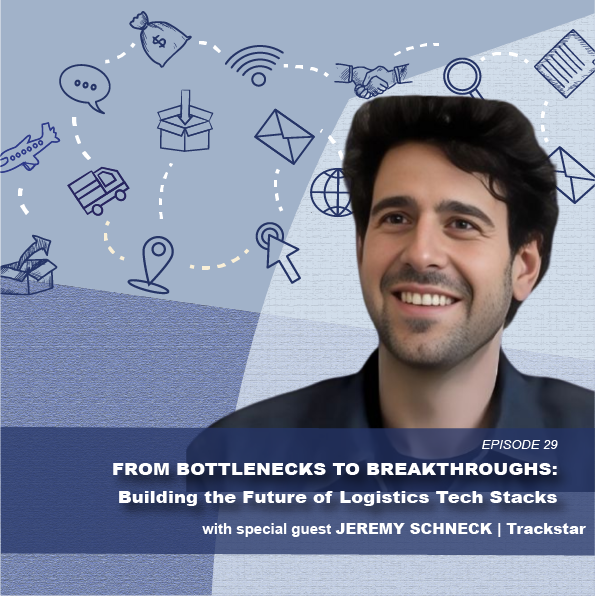
The supply chain’s Achilles heel has always been integration. In this episode of Parcel Perspectives, Glenn sits down with Jeremy Schneck, Co-founder of Trackstar, to explore how his company is breaking down the barriers between shippers, 3PLs, and warehouse management systems (WMS).
Jeremy explains why outdated legacy platforms and a fragmented WMS market have created costly inefficiencies—and how Trackstar’s universal API acts as a “Rosetta Stone” for supply chain data. From enabling new software adoption to streamlining order editing, Trackstar helps software providers, shippers, and 3PLs work together seamlessly.
Listeners will learn:
• Why shippers struggle to evolve their tech stacks as their business grows
• How universal APIs unlock innovation for software providers
• Why now is the best time to invest in logistics technology
Packed with insights, this episode shows how Trackstar is driving flexibility and resilience across the logistics ecosystem.
[00:00:00] Jeremy Schneck: I think shippers actually have had a really hard time with this historically where a shipper works with a 3PL, they buy their software stack, maybe it gets connected, but things change. Businesses grow. They add new 3PLs, they expand, they go from D2C to retail. Businesses are always evolving. But the challenge is, once they set their tech stack up once, as their business evolves, their tech stack stays behind, because they can’t keep up with their growing business.
[00:25:00] Jeremy Schneck: So, they have stagnant tools or they’re stuck with the 3PL that can’t support them properly. And what’s nice about Trackstar is we add flexibility into their infrastructure.
[00:35:00] Glenn Gooding: Welcome to Parcel Perspectives, the podcast dedicated to small parcel shippers. I’m Glenn Gooding. In each episode, we dive into insights, best practices. And strategies to help you navigate this complex and costly market.
[00:00:40] Glenn Gooding: Hello, and welcome to another edition of Parcel Perspectives. I’m Glenn Gooding. Today I’m joined by Jeremy Schneck, co-founder of Trackstar. A company often called the “Plaid for supply chain,” Trackstar is making it dramatically easier for software providers to connect with warehouse systems—what used to take months into just minutes.
[00:01:10] Glenn Gooding: With a background in finance and investing, Jeremy is now focused on reshaping how supply chains integrate and innovate. I’m very excited to dive in with him on breaking through bottlenecks and building the future of logistics in tech. Jeremy, welcome to the show, my friend.
[00:01:27] Jeremy Schneck: Thank you. I appreciate you having me. I’m excited to talk about all the cool stuff we’re seeing in supply chain and how Trackstar powers a very small piece of it.
[00:01:36] Glenn Gooding: Excellent, excellent. Jeremy, I was hoping—could you start by sharing just a little bit about your background and how you came to focus on solving these integration challenges?
[00:01:45] Jeremy Schneck: Yeah, I think what I like to say is we stumbled into building an integration layer for the supply chain. My background’s in finance, as you highlighted. I used to invest in retail, consumer, [and] food and beverage companies at a fund called Oak Hill Advisors. My co-founder, Daniel, who is amazing — he was an early product manager at Datadog.
[00:02:06]Jeremy Schneck: I don’t know how familiar your listeners are with Datadog, but [it is a] multi-billion-dollar cloud monitoring and observability tool for developers. The two of us originally had a different insight. Like a lot of startups, we were building something different, and it led to our current product. But based on my background and his background, we decided to start building tech in the eCommerce space.
[00:02:25] Jeremy Schneck: We had an insight, which is not that crazy of one, that running a brand is very difficult. Brands are always putting out hair-on-fire problems across their business and operations. So, we built what we like to call a “Datadog for eCommerce.” We would help brands catch issues across their tools — broken checkout flows, leaked discount codes, site speed problems, and more.
[00:02:45] Jeremy Schneck: What ended up happening is brands said, “Hey, what you’re solving is nice to have, but it’s not mission-critical for us. Where we really lack visibility is in our supply chain ops. Would you ever be able to integrate with our supply chain tools and catch issues across that?” And we’re like, “Maybe — that’s really interesting.”
[00:03:03] Jeremy Schneck: “What would you want us to integrate with?” And we had 30-something customers at the time, and they all said, “We would love it if you [integrated] with my WMS.” The challenge was those 30-something customers were on 25 unique WMS [platforms]. And we’re like, “Yeah, yeah.” We’re like, “Whoa, that’s crazy. We can’t go build 25 integrations just to support 30-plus customers.”
[00:03:22] Jeremy Schneck: And honestly [it] just isn’t economically viable for us to put in that integrational lift. We looked for a universal API, something that would help us connect to these systems more easily. Nothing existed on the market, and then Daniel and I joked, “Someone should really solve this problem. But that’s a really hard problem to solve.
[00:03:39] Jeremy Schneck: It’s painful, it’s not easy. Good luck to whoever does it.” Fast forward six months later, and we realized we should be running towards hard problems, and we built the integration infrastructure we always needed. So, we [fully] pivoted. We stopped building the monitoring product and we decided to build a universal API for WMS to provide that integration support that we had desperately needed[previously.
[00:04:08] Glenn Gooding: Wow. So, you kind of stumbled into this by listening to customers, huh?
[00:04:12] Jeremy Schneck: Yeah, [it’s the] best way to do it, and a hundred percent [we] stumbled into it. I think what’s interesting about supply chain is, I feel like there are two types of people in it — folks who have been in the industry for many years and have incredible expertise, and then, people who stumble in and never leave because they realize how much complexity and nuance there is.
[00:04:33] Jeremy Schneck: Being in the industry makes me realize how crazy it is — how we get goods on time with such consistency, given how many different legs there are in the chain, from a product moving from A to B.
[00:04:43] Glenn Gooding: Yeah, I think our listeners wouldn’t have to stretch too far to put me into the proper bucket — probably the former versus the latter, right? I like to tell folks I started in this industry when I was 10, but I’d be lying blatantly. So, I’ve just been doing it a while. Well, if you don’t mind, you really have my attention because the supply chain, as nuanced, as sophisticated, as complex as [it] has always been — the Achilles’ heel in my mind has been those pinch points, those roadblocks: the lack of integration, the lack of communication. You have me incredibly interested in trade. If you don’t mind, I’d like to dive into some details with you. Why have 3PLs and WMS integrations been such a persistent bottleneck for shippers?
[00:05:35] Jeremy Schneck: Yeah, I think it’s important to understand why integrations even are relevant here. It’s WMS, and your listeners likely all know this, warehouse management system, [the] system of record for all data in a warehouse. It tracks the [movement of] goods: what’s arriving at the warehouse, what inventory’s in the warehouse, [and] what goods are leaving.
[00:05:54]Jeremy Schneck: Order data, shipment data, and more. So, we’re talking about super valuable information. I think something like 95% of products that consumers purchase at some point flow through a warehouse. WMS [tracks] all that information—really valuable data. Now, the challenge is, why are [integrations] so hard? It’s twofold.
[00:06:12] Jeremy Schneck: WMS, for the most part, [are] older, more outdated legacy systems. The way the industry’s evolved is they are not as you think about pure SaaS companies. [They are] more [like] legacy enterprise software, and legacy enterprise software generally does’t have the same ease of integration as a modern tech platform like Shopify.
[00:06:34] Jeremy Schneck: We happen to love integrating with REST API, but there are all different ways you can get data. There’s REST API, there’s GraphQL, there’s SOAP, there’s EDI, [and] there’s SFTP buckets. So, one: old, outdated legacy systems that are generally hard to integrate with. And WMS—the bread and butter isn’t connectivity; [it’s] powering warehouse operations. The second side of it is there’s hundreds of different WMS out there. I break WMS into two buckets: there’s off-the-shelf systems anyone can buy. So, if me and you wanted to open a warehouse—I’m based in New York City, but [say] in New York City for whatever reason, we can buy one of dozens and dozens of systems off the shelf: Shapiro, Deposco, VeraCore, Manhattan, Blue Yonder, Peoplevox, MintSoft, et cetera, et cetera.
[00:07:14] Jeremy Schneck: But that’s only half the story. There’s also a lot of 3PLs that have been around for 10, 20, [or] 30 years that have built their own custom WMS in-house. So, I think about the ecosystem of WMS: we’re talking about valuable data locked away in a highly fragmented market where no WMS has significant market share, and [they are], for the most part, older, more outdated legacy systems.
[00:07:34] Jeremy Schneck: So, if you are a company that needs a tool to connect to your WMS, that tool is in for a rude awakening, because everyone they work with is on a different system. And each individual system to connect with is very, very difficult. So, WMS and supply chain broadly—there’s not what I call “data interoperability.”
[00:07:52] Jeremy Schneck: Systems don’t play very nice with each other because of that dynamic: fragmentation plus legacy systems.
[00:08:01] Glenn Gooding: Boy, I couldn’t agree more with you. Could not agree more. So, kind of—if you create a conduit or a “Rosetta Stone” to communicate effectively with all WMSs that are out there for the variety of reasons, right?
[00:08:16] Jeremy Schneck: Yep, exactly. That’s a great analogy. What we do as a business is we build integrations into all of the different WMS, whether it’s an off-the-shelf system or a 3PL with a custom system. We normalize and map that into a common data model. So, your Rosetta Stone analogy—for a single, unified data model. And then software companies connect to our unified data model once.
[00:08:37] Jeremy Schneck: And now they’re pre-integrated with every system we support. So, we have 90 integrations today, and it’s a healthy number, but we’re still just scratching the surface of the market, given how fragmented and how many systems there are. But when we add our 91st—this is the beauty of our product—a software company connects to our API.
[00:08:53] Jeremy Schneck: They’re now integrated with 90-plus systems. But when we add our 91st, 92nd, [or] 93rd integration, because we map it to that common data model, you don’t need to do any extra work. So, once you’re integrated once, you have support for all existing and future integrations we build. So now, those software companies—they don’t need to worry when they onboard a brand or a warehouse as a customer.
[00:09:15]Jeremy Schneck: “Oh no, what WMS are you on?” They can say, “No, I already support it. I’m integrated with Trackstar, and they’re already pre-integrated with your system. I can onboard you immediately in one click.” So, it’s definitely a really powerful product to help software innovate more easily in the space.
[00:09:31] Glenn Gooding: Fascinating. Fascinating. So, let’s break into why a little bit, if you don’t mind, Jeremy, just for the listeners out there. Can you describe what hidden costs with regard to time, money, [and] customer experience are these bottlenecks that you’re fixing? What do they create as far as hidden costs for businesses today?
[00:09:50] Jeremy Schneck: Yeah, I can talk about how we benefit the ecosystem. So, if you are a shipper and you want to buy new software—let’s say it’s an inventory forecasting tool, a returns management system — it could be a shipping software, whatever it may be. What happens is you want to, as a shipper, you want to buy that software, but you can only use that software if it integrates with your WMS, because that software needs to ingest your data.
[00:10:12]Jeremy Schneck: The challenge is if you’re a shipper, you say, “Hey, software, do you integrate with my WMS?” They go, “No.” And then they ask what system you’re on, and you’re on some 3PL’s custom system, [and] they say, “Hey, I’m never going to build that. It’s going to cost me more to build that integration than it is to onboard you as a customer.”
[00:10:27]Jeremy Schneck: And now what happens is, because of this lack of digital interoperability, that shipper cannot buy best-in-class software that they need to improve their operations. And from the software company’s point of view—now, that’s who our customers [are]. We sell [to] software companies. The software companies have two major challenges.
[00:10:43]Jeremy Schneck: They want to onboard as many customers as possible. They want to tell that shipper, “Hey, yes, we can support you. We can have that integration.” But there’s two key dynamics at play. One: they don’t have the engineering resources to build each integration in-house. Building 90-plus integrations would be a multimillion-dollar lift.
[00:10:59]Jeremy Schneck: They don’t want to do it. So, inevitably, building integrations themselves [are a] huge cost center. It would cost them literally hundreds of thousands, if not millions of dollars to do this internally. So, they end up turning away business. But now, the other unlock that we have is once a software company is integrated with our API, they can confidently go to any shipper and say, “Hey, I can onboard you. I already support your system.”
[00:11:20]Jeremy Schneck: So, not only is it saving them engineering resources to unlock more WMS integrations, it also is really effective in letting their sales team close any deal confidently. And what’s great is Trackstar’s happy, because the software company is [and] the customer’s happy. The shipper loves it, because now the shipper is buying software that otherwise would’ve said, “Hey, I can’t support you.”
[00:11:39] Jeremy Schneck: And then the 3PLs also love it because they want to be tech-forward. They want to tell shippers, “Hey, my 3PL—if you partner with me—our WMS is really interoperable with other software. We are a tech-forward player in the space, and Trackstar enables all of that: shippers get great software, software companies close more deals, and 3PLs [can] advertise their WMS works with a lot of different systems because of Trackstar. So, it is really “a rising tide raises all ships” for everyone in the industry here.
[00:12:06] Glenn Gooding: Great. So, let me just dive into one detail for you as it stands out to me. I think the listeners would like to learn more about—you’d mentioned in the 3PL environment, and correctly by the way, that there’s a lot of legacy, locally built WMS solutions out there. How does Trackstar integrate in that environment efficiently?
[00:12:26] Jeremy Schneck: Yeah. Efficiently is a hard word, right? I think the beauty is, all we do is WMS integrations. All other software companies in the supply chain, ops, [and] commerce space—they’re building core products, and then they also may build some integrations. But integrations aren’t their core product. Why I’d say “so first” is because we are experts in this. What’s really nice is—
[00:12:51] Jeremy Schneck: Two years ago, I wouldn’t have said this. Now I will. We are [the] world’s foremost expert at WMS integrations. We’ve done this 90-plus times—more than anyone else. It’s all our team lives and breathes. So, we know all the gotchas, whether it’s a tech-forward WMS, which is more rare, or an old, outdated legacy system —
[00:13:07] Glenn Gooding: — which is much more common.
[00:13:09] Jeremy Schneck: Much more common. We’ve seen every flavor of it. So, when we build an integration, we know the gotchas, we know what questions to ask. We often actually know the APIs better than their own teams. But there’s always a way to get data out. So, let’s say a WMS has their own custom system. They don’t have an API built out—we’ll integrate. We’ll meet the warehouse wherever they are technologically. So, if they need to set up an SFTP server and upload files on a daily basis, we will ingest that, and then, our customers still experience Trackstar’s API.
[00:13:42]Jeremy Schneck: I think it’s part of — we’re integration experts. My co-founder Daniel led an integrations team at Datadog. So, he lives and breathes [this] and knows it better than anyone. And it’s the benefit of—we’ll meet customers wherever they are. Why I jokingly open with “it’s not always that efficient” is [because] these integrations aren’t easy.
[00:13:57]Jeremy Schneck: They take, for us, weeks—they’re not taking months. And we’ve also built a lot of infrastructure to be able to spin these up more quickly. Part of the beauty, again, of focus. And then the last piece is—I had mentioned a software company doesn’t want to build an integration to a 3PL with a custom system because it costs them a bunch of money, and they don’t know the next time they’re going to onboard someone else on that system.
[00:14:20]Jeremy Schneck: The beauty for Trackstar is we work with dozens and dozens of software companies that use our API, that sell to thousands of warehouses and merchants. So, for us, when we build a connection into a bespoke system—a 3PL’s bespoke system—we’re still able to reuse that connection. Software Company A uses our API to onboard someone working with that warehouse. Software Companies B, C, and D will also eventually onboard someone in that warehouse as well.
[00:14:44] Jeremy Schneck: So, we’re able to build those really niche, custom systems because we’re reusing it across our very broad customer base of software tools.
[00:14:53] Glenn Gooding: Great. Great. Wow. So, how do universal APIs—like what Trackstar has built—simplify integrations across multiple WMSs and multiple 3PLs in that environment?
[00:15:08] Jeremy Schneck: It’s a great question. It is not easy. I think the hard part is, when we first started building the product—
[00:15:15] Glenn Gooding: —I didn’t say “efficient” that time.
[00:15:16] Jeremy Schneck: Yeah, true, true. We had to create our own common data model. So, we would look at all the different systems and how each WMS calls different fields and map it to what we created—our own data model, which is really our own schema.
[00:15:31] Jeremy Schneck: And then, once we developed our own schema, which leaned on our expertise of building so many systems, we just had to map each system to that same schema. I think it’s harder in the beginning. It’s harder in the beginning. Now that we have a very defined schema, adding a new system—we’re able to quickly spin that up.
[00:15:47]Jeremy Schneck: But no, it is the beauty of our product. We map everything to that common data model. And then, once that’s done, software companies connect once and have all the integrations supported. Universal APIs are really helpful in letting software companies focus on what they do best. Like I said, whether it’s inventory forecasting, returns, shipping, [or] helping with tariffs—whatever it may be.
[00:16:05]Jeremy Schneck: And the universal API model and mapping—we do all the mapping work, and that really helps streamline things for the software companies.
[00:16:16] Glenn Gooding: Great. Can you share another example of where this particular approach has really simplified integrations for a user case or accelerated operations on that front?
[00:16:28] Jeremy Schneck: Yeah, I can give you a great example. One of our customers is an inventory forecasting tool that sells to—call it—lower- to mid-market shippers, $10–100 million of top line.
[00:16:40] Glenn Gooding: Okay.
[00:16:41] Jeremy Schneck: Their inventory forecasting tool needs to ingest two data sources. Sales data—inventory forecasting, at its core, is supply and demand. What’s your demand, and what’s your supply? Demand being, how many orders do you have; and supply being, how much inventory do you have? This inventory forecasting tool was really struggling, because every time they would onboard a customer, that customer would say, “Hey, I need to integrate with your systems. What WMS are you on?” And every single time, there [would] be a different WMS.
[00:17:08]Jeremy Schneck: They built a couple [of] integrations in-house—I think they built ShipHero, Logiwa, and maybe one more WMS in-house. But what ended up happening is, every time they met with a new brand or new shipper, that brand would name a new system.
[00:17:19] Jeremy Schneck: The engineering team started pushing back. They said, “Hey, we’re focusing on the core product. We can’t build more integrations.” And this was really frustrating for the sales team, because they were meeting with dozens of brands a month and turning them all away.
[00:17:30] Jeremy Schneck: And then, that company found out about Trackstar. They built an integration into our API, and it was the sales team’s dream come true. Now, every time they meet with a brand or shipper, they’d say, “What’s your WMS?” They go, “Oh, we already support it.” Once in a while, they’d say, “Hey, Trackstar, I noticed you don’t support this system. Can you build it?” We’d quickly add it to our API, and they were able to go from adding a couple of merchants a month to adding dozens of merchants a month, dozens of shippers a month—which was a huge unlock for them.
[00:17:58]Jeremy Schneck: And then, the engineering team loved it, because they didn’t have to build any integrations at all. So, instead of saying, “No, no, no, we only can build a few,” they now were able to exclusively focus their time on making their product as robust as possible.
[00:18:09] Jeremy Schneck: But it doesn’t stop at inventory forecasting. We don’t care how the data gets used. Like I said, returns management software needs this data. There’s a cool new use case with a lot of software companies doing tariff refunds, tariff drawbacks—and we’re helping. They need to connect to shippers’ WMS to power that functionality.
[00:18:25] Jeremy Schneck: We work with tech-forward lenders who give loans to shippers, and they want inventory data as part of their underwriting process. Shipping solutions—there’s a whole slew of software helping 3PLs create invoices or manage cash flow better. And every single time, they need to integrate with the WMS to onboard a customer.
[00:18:42]Jeremy Schneck: So, the coolest thing for us is we’re seeing a lot of new software get built in space, and we’re able to help them grow more quickly because they don’t have to think about [it]. They don’t have to spend half their engineering time on integrations. They can focus all their time on building best-in-class operational software.
[00:18:59] Glenn Gooding: Is it fair to assume then that the solution Trackstar is bringing to the marketplace—is it fair to assume that it’s enabling more innovation with the existing engineers and developers out there?
[00:19:15] Jeremy Schneck: It’s the best part about our product. What’s actually really interesting is a lot of our customers are early-stage startups. They’ll meet with venture capital firms, and the venture capital firm will say, “How are you going to handle integrations?” And the company will be like, “I actually don’t know. We’re nervous.” And the venture capital firm will say, “You should talk to Trackstar. Your idea—if they didn’t exist—would be almost impossible to get off the ground. But because they exist, you actually [do not] need to worry about integrations. Go talk to them.” And they send us tons of deals.
[00:19:46]Jeremy Schneck: But it’s really cool seeing—there’s a lot of early-stage tech using our API that’s growing incredibly quickly. Some people told us, “Hey, if it wasn’t for you guys, we wouldn’t have built our product, because it would’ve been too challenging.” So, yes, it is. It’s fair to say it’s probably my favorite part about the job—seeing early-stage software companies use our product, enjoy the experience, and [how] it leads to a better ecosystem.
[00:20:11]Jeremy Schneck: Amazing new tech that can be built more quickly, helps shippers and warehouses improve their operations, which creates better outcomes for everyone involved.
[00:20:21] Glenn Gooding: Awesome. So, in practical terms, Jeremy—infrastructure-as-a-service model, right? Flexible infrastructure-as-a-service model—what does that mean to a shipper specifically?
[00:20:38] Jeremy Schneck: What’s—I think shippers actually have had a really hard time with this historically where a shipper works with a 3PL, they buy their software stack, maybe it gets connected, but things change. Businesses grow. They add new 3PLs, they expand, they go from D2C to retail. Businesses are always evolving. But the challenge is, once they set their tech stack up once, as their business evolves, their tech stack stays behind, because they can’t keep up with their growing business.
[00:21:08] Jeremy Schneck: So, they have stagnant tools or they’re stuck with the 3PL that can’t support them properly. And what’s nice about Trackstar is we add flexibility into their infrastructure. A brand can easily add a second 3PL node on a different WMS, and their software tools can one-click connect, and they have no disruption to their operations.
[00:21:30]Jeremy Schneck: I think, generally speaking, shippers have had a pretty stagnant tech stack. Once they implement an ERP and whatever 3PL and WMS they’re on, nothing changes. And buying new software became really painful because of the implementation lift. And now we’re seeing the lift for shippers to use new technology massively decrease.
[00:21:50Jeremy Schneck: So, they’re buying better tech, and a lot of that’s because of simplifying integrations and that tech interoperability. So, it also lets them have more—like you said—more flexible infrastructure. They can buy whatever tools, because all their tools play nice with each other and slot solutions in and out much more readily.
[00:22:07] Glenn Gooding: Incredible. So, if I heard you right before, Jeremy—you’d mentioned you standardize data, right? You bring it in, you standardize it, it comes across. Are you giving any thought to practical applications for what that standardized data can do for companies? Or are you leaving it to them to solve?
[00:22:27] Jeremy Schneck: The answer’s both. Historically, we left it to them to solve. We would tell software companies, “Hey, you know your customers. We’re a developer product for you. We don’t want to be prescriptive, telling you to build X, Y, Z. It’s not our job.” But what we ended up noticing is, people weren’t asking us to tell them what to build, but they wanted to lean on our expertise.
[00:22:49] Jeremy Schneck: A really cool use case we see is order editing. Customer support tools—if you ever went to a brand’s website and saw a little chatbot in the bottom right, that’s a customer support tool that can help the end consumer answer questions.
[00:23:02] Jeremy Schneck: We were talking to some of these companies, and they’re like, “Hey, what do you think we can do with your API? Why would we want to use WMS data?” And I said, “Have you ever thought about order editing?” So, now a customer buys a red T-shirt, they realize, “Oh no, I meant to buy a blue T-shirt.” They go to the chatbot and say, “Hey chatbot, can you swap my T-shirt for a blue T-shirt?”
[00:23:20] Jeremy Schneck: Without WMS connectivity, the workflow is: the chatbot says, “Email this person at the brand.” The person emails the brand. The brand emails the warehouse. The warehouse emails the person back. It’s a week-long flow just to get told, “We haven’t shipped the red T-shirt out yet. We can swap the order if you want.”
[00:23:36] Jeremy Schneck: Now, the customer support tool is integrated with the brand’s WMS. So, I—as an end consumer—can go, “Hey, I bought a red T-shirt accidentally. Can I switch it to blue?” The customer support tool pings the WMS and says, “Yeah, we haven’t shipped it yet. We can update that order for you. Do you want us to update it?” You go, “Yes.” It’s all done in 30 seconds versus a multi-week-long delay.
[00:23:56]Jeremy Schneck: We were prescriptive there. A potential customer was saying, “How can I use this data? How would this help my product?” And we had insightful opinions on how it could be used. We’re seeing the power of incredible flows for them.
[00:24:08] Jeremy Schneck: So, the answer is—we originally weren’t prescriptive, but then we realized people want to lean on our expertise in space. So, we’re happy to give people thoughts on different workflows. We generally still want them to—they obviously need to—know their customer, which they do.
[00:24:23] Jeremy Schneck: But we provide some guidance around the margin for how they can improve their products using this really rich data source, which is WMS.
[00:24:30] Glenn Gooding: Awesome. Awesome. Sounds like you’re continuing to listen to the client.
[00:24:34] Jeremy Schneck: That’s—I would say that’s the best thing we’ve ever done: we listen to our customers, always. We haven’t built a single integration or built a single feature without customer input in the last 18 months. Everything is dictated by customers telling us what they want and when they want it.
[00:24:51] Jeremy Schneck: And it’s how we built a best-in-class product. We keep our ear as close to the ground with customers as possible, catching up with them as regularly as possible. The best advice we got was, “Listen to your customer.” And we take that—we hold that true to heart.
[00:25:06] Glenn Gooding: Good for you. Good for you. So, a shipper listening to our conversation today, and they feel a little stuck, a little overwhelmed in their integration bottlenecks—what is the first step that they can take?
[00:25:22] Jeremy Schneck: Really good question. It somewhat depends on where they’re stuck. My gut is every shipper has an individually unique problem related to their integrations. Someone wants to buy an inventory forecasting tool, and it doesn’t connect. That’s a very different challenge than [someone who] wants to buy a return software [tool] that doesn’t connect. The same solution—which is Trackstar—can help power that connectivity for the software company.
[00:25:50] Jeremy Schneck: It depends what their actual integration challenge is at the moment. There are ERP challenges. There are situations where you’re moving from one warehouse to another, and the data’s not able to move forward. My gut advice—from my lens at Trackstar—is that there’s probably a point solution that solves your unique pain point, and that point solution should solve the integration challenge for you.
[00:26:21] Jeremy Schneck: I actually don’t think integration should be the burden of the shipper. The integration should be the burden of the software company to connect to the shipper’s systems.
[00:25:24] Jeremy Schneck: Unfortunately, my answer here is—it depends a little bit on what their unique challenge is, [because] we run into hundreds of different integration challenges people can face.
[00:26:27] Glenn Gooding: Yeah, I could imagine. What has you most excited about where logistics technology is headed, Jeremy?
[00:26:34] Jeremy Schneck: Yeah, my worldview on logistics technology is—it is behind the curve versus other types of software categories, whether it’s technology in the healthcare space or FinTech. There was a massive FinTech boom. A lot of that was built on the back of Plaid, which is the universal API for banking data.
[00:26:57] Jeremy Schneck: And it’s whose model we molded for the supply chain space. I think logistics tech is a little behind other categories. A lot of this is related to integration challenges. What’s really exciting to me for both shippers and technology companies is shippers realize they need to button up their operations.
[00:27:16] Jeremy Schneck: I think five or ten years ago, everything was focused on, “Let’s dump marketing dollars into Facebook, because every dollar we put in—I’m making it up—gives us $4 in return. We don’t need to have highly buttoned-up and profitable operations, because we could pour money into the Facebook slot machine.”
[00:27:32] Jeremy Schneck: And then I think shippers also had this worldview of, “My supply chain is fine unless some crazy supply chain shock happens. But when’s that going to happen?” And then, next thing you know—over the last five to ten years—we have a new supply chain shock every year: tariffs most recently, then there was COVID, Suez Canal getting blocked, port strikes in Los Angeles, the Baltimore Bridge issue. Every six to twelve months, we have a new shock to the supply chain system.
[00:27:59] Jeremy Schneck: And brands, I think, are very eyes-wide-open: “We need best-in-class technology to help us weather these shocks.” So, what’s really exciting for me is—marketing tech, health [tech], all these other technologies had this massive boom—we’re seeing the same thing in logistics and supply chain tech, because everyone’s realizing operations are what makes a business survive and thrive.
[00:28:22]Jeremy Schneck: Every dollar of margin you can save is incredibly valuable to profitability. So, more than ever before, we see tons of new software companies popping up in the space every day, every week.
[00:28:35] Glenn Gooding: I’m so excited for you, Jeremy. I think you’ve really stumbled onto a particularly useful need in this space. It’s kind of a universal need, if you will.
[00:28:43] Jeremy Schneck: I like that. And “stumbled in” is definitely the right term. We found a really cool, compelling problem, and we’re excited to be solving it.
[00:28:51] Glenn Gooding: Good for you. So, if you were to try to leave our listeners with two or three key takeaways from our discussion, what would those be, Jeremy?
[00:29:00] Jeremy Schneck: I would say, if you are a shipper or software company, it’s that integrations are no longer a blocker if you use a solution like Trackstar. Interoperability—is very doable, leveraging our technology. And then, I think the last takeaway is less related to Trackstar and more related to the ecosystem.
[00:29:19]Jeremy Schneck: We have a really great line of sight into, like you highlighted before, technology entering space. And I think the ecosystem is as strong as ever. There’s amazing technology helping companies—whether [to] weather the impact of tariffs, improve returns, make their operations [more efficient], or make sure they have the right shipping providers at the right time to save tons of money there.
[00:29:42]Jeremy Schneck: It’s the best time ever to be in supply chain tech. And I think there’s only more and more challenges to solve and cool businesses to build. So, I would also tell people: if you’re thinking about building technology in the supply chain and ops space, you’re solving real pain points that impact the end consumer. And I’d recommend doing it. We’re seeing a lot of great tech building.
[00:30:05] Glenn Gooding: Okay. I can’t thank you enough for joining me today and sharing your thoughts and your insights. I think they’re brilliant, frankly. Hey, for anyone who wants to learn more about Trackstar—the work your team’s doing—what’s the best way to connect with you and your company, Jeremy?
[00:30:19] Jeremy Schneck: Yeah, I am always available. People can reach me at jeremy@trackstarhq.com. Or, if they don’t want to email me directly, our website—TrackstarHQ.com (T-R-A-C-K-S-T-A-R-H-Q dot com)—has a signup form where people can ping it, and we respond really quickly. Or—we were talking about this before the recording started—I go to a lot of trade shows. If anyone wants to say hi to me at a trade show, I’m always available and happy to make time.
[00:30:46] Glenn Gooding: I look forward to sharing a cup of coffee with you.
[00:30:49] Jeremy Schneck: Yes, I definitely would love that. That’d be awesome.
[00:30:53] Glenn Gooding: Same. Well, thank you, Jeremy. And listeners, thanks again for tuning into another edition of Parcel Perspectives. Until next time.
[00:31:06] Glenn Gooding: Thanks for listening to Parcel Perspectives hosted by me Glenn Grig. I’ve been in the small parcel space for 37 years, starting with a deep and broad background, working for one of the major carriers as an operator and industrial engineer later managing pricing at the highest level. For the largest, most complex shippers in the world.
[00:31:24] Glenn Gooding: Since then, I’ve been a national thought leader and worked to help drive strategy for clients from Fortune 50 companies to start up e-commerce businesses, helping them more competitively align in this complex and expensive market. If you enjoyed the show, please subscribe and share with friends. Join us next time for more expert advice and strategies to stay ahead of the shipping game.
Key Topics with Timestamps
- 00:49 From Finance to Supply Chain Tech
- 04:59 Why WMS Integrations Are Broken
- 12:09 Building a “Rosetta Stone” for Supply Chain
- 14:55 Universal API in Action: Real Use Cases
- 20:21 Giving Shippers Flexible Infrastructure
- 22:08 Turning Data into Real-World Solutions
- 25:08 What Shippers Should Do Next
- 28:53 The Future of Supply Chain Tech
Other Podcasts
-
10
Jan 22, 2025
A Consultant’s Role in Supply Chain & Carrier Contracts
Discover how logistics consultancy revolutionized small parcel shipping for Right Manufacturing Systems in this episode of Parcel Perspectives. Join Glenn Gooding and Ian Hartman as they discuss achieving a 23% reduction in shipping costs, leveraging data for smarter decisions, and the invaluable insights gained from expert consultancy. Tune in to learn how deep industry knowledge and strategic negotiations can transform your logistics operations.
-
9
Nov 13, 2024
How Reverse Logistics Shapes Holiday eCommerce
Join Glenn Gooding and Cathy Roberson as they dive into the world of reverse logistics. Discover how carriers like UPS, FedEx, and USPS are adapting to the growing returns trend, and explore innovative strategies for handling oversized items and complex returns. Learn about the latest trends, including "bracketing" and sustainable practices, and how AI is transforming the returns process.
-
15
Feb 19, 2025
Future Vision: Key Supply Chain Investments for the Next Decade
The Future of Logistics is Here. Join Glenn Gooding and special guest Benjamin Gordon, Managing Partner and CEO at Cambridge Capital, in this week's episode of Parcel Perspectives as they explore the cutting edge of supply chain management. This episode covers it all: the AI revolution, the eCommerce explosion, the crucial role of customer experience, and the growing importance of sustainability. Get expert insights into future investment opportunities and discover how to build a resilient supply chain that can withstand any disruption. Tune in and future-proof your business!