 28
28
 Sep 18, 2025
 18:45
18:45
UPS, FedEx, & Beyond: What Shippers Need to Know About Q4 Demand Surcharges
In this episode, Glenn Gooding breaks down the reality of Q4 demand surcharges as USPS, UPS, FedEx, DHL Express, and OnTrac roll out new fees. With retail sales slowing and carriers cutting capacity, the optics of added costs are tough for shippers. Instead of dissecting every rule, Glenn focuses on action: measure your exposure, revisit cart thresholds, and align with carriers through better forecasting and early releases. He also emphasizes quid pro quo — operational support in exchange for surcharge relief. Glenn closes with a call to prepare: know your contract commitments, explore gig and regional carriers, and ensure your tech stack is ready so you enter peak season with options.


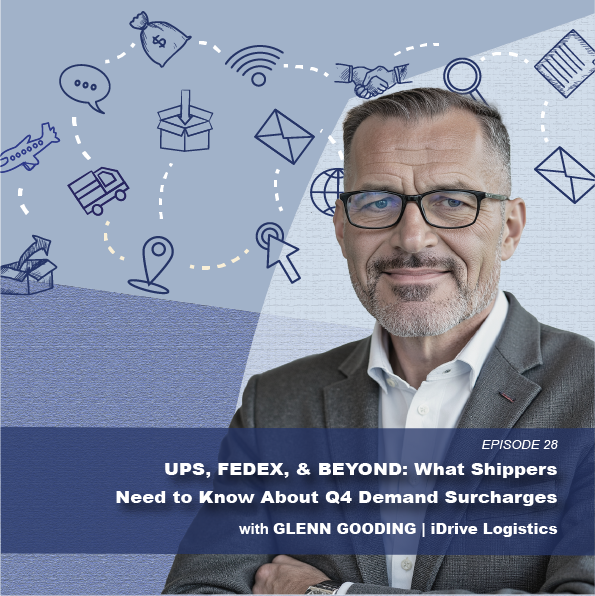
Demand surcharges are everywhere in 2025 and they’re not going away. In this episode of Parcel Perspectives, Glenn Gooding explains how shippers can take control rather than just absorb the costs.
This episode covers:
• The optics of carriers cutting staff while adding surcharges
• Why the first step is quantifying exposure and revisiting free-shipping thresholds
• How to collaborate with carriers through forecasts, early releases, and added shifts
• The value of quid pro quo: operational relief in exchange for surcharge concessions
• Knowing your contract commitments across USPS, FedEx, and UPS
• Building flexibility with alternative carriers, gig networks, and TMS readiness
Glenn closes with a reminder: peak season planning requires more than acceptance. Shippers who prepare, collaborate, and diversify will be best positioned to weather Q4 surcharges.
[00:00:00] It’s 2025. Retail sales are down. The market is struggling. If you follow the press carriers are compressing or reducing their capacity. They’re making staffing reductions. So, the optics don’t look too good when you’re talking about a carrier that’s doing early buyouts, layoffs, shutting down operations, drawing down volumes in other places while simultaneously coming to you saying, “We need to impose demand surcharges.”
[00:00:32] So, there is, I think, some room for some pragmatic discussion with the carrier or carriers that you’re talking with, and the reality is you’re going to have a variety of responses.
[00:00:45] Welcome to Parcel Perspectives, the podcast dedicated to small parcel shippers. I’m Glenn Gooding. In each episode, we dive into insights, best practices, and strategies to help you navigate this complex and costly market.
[00:00:59] Hi. Welcome to another edition of Parcel Perspectives. I’m Glenn Gooding. Today, I’d like to talk to you about demand surcharges that are in the marketplace today. Any of you that are active procurers of small parcel, anybody that’s active on LinkedIn, has seen a ton of folks out there trying to portray themselves as thought leaders, wanting to be the first out there to talk about UPS’s demand surcharge release or FedEx’s demand surcharge release.
[00:01:30] I’m not here to talk about the particulars of those right now. I want to ask the more profound question and offer you some insights and some ideas around answers to that question. The question is: now that we know that every major legacy carrier is imposing a demand surcharge of some sort—let’s go down the list.
[00:01:55] USPS, DHL Express, UPS, FedEx, and OnTrac—super regional. They’re all imposing demand surcharges of some sort—some methodology, some more complex than others. I’m not here to talk about those complexities right now, though. It’s all information available that’s out there. But given that, what do you, as a proprietor, as someone [who is] an executive responsible for the eCommerce marketing plan, as a 3PL operator—what can you do about it?
[00:02:41 Do you just take them? What does that do to your potential planned profits in Q4—which, in the retail sector, is usually the make-or-break time in the retail sector. It can be untenable. So, I’d like you to consider some things that we can actually [do] rather than sitting on our hands or playing victim to a marketplace that appears to be imposing a demand surcharge that you can’t get away from.
[00:03:10] [It’s,] what can you practically do about it? I think the first place to start is understanding what is the planned impact to your company. That answer’s going to vary. It’s going to be contingent on the carrier or carriers you source with today, what the specifics of the demand surcharge methodology are for those carriers, what your planned volumes will be.
[00:03:37] You’re going to have to have a lot of facts put together, and then you’re going to have to try to muddle through the particulars and the complexities of those particular demand surcharge rules, if you will. It’s a different answer for every carrier. Then, I think once you have a general understanding of what the potential downside is for you, the impact, and it can be profound, you need to begin to look at things like: Do you need to revise your shopping cart options? How about your subsidized shipping strategies? If in Q1, Q2 Q3, it makes sense for you from a planned transportation expense to offer free shipping on all orders over a hundred dollars, is that same threshold tenable for you in Q4 when you’re going to subject yourself to demand surcharges? You need to look at those. You need to plan for that, and you need to consider changes.
Third, this one’s critical. You need to collaborate with your carrier or carriers. Say it again. I didn’t say beat them up. I said you need to collaborate with them. I’m going to be the first to tell you, in my experience of four decades of being in this space.
[00:05:02] One place that the carriers consistently fall short of is having a consultative, collaborative partnership with their customers. You have to force that. You can’t wait for it to come to you. Some things to discuss with them: Is there a way for you to more efficiently align with that carrier for this timeframe?
[00:05:31] So, let’s stop for just a quick second. Are demand surcharges bad? From a cost perspective, they are. Are they practical? To some degree. Do they make sense to some degree? I would say to some degree, they do make sense. Carriers build an operation, they build a capacity, they staff it accordingly, and Q4 is notoriously a huge spike in volume for them.
[00:05:59] They have to do a lot of seasonal hiring, a lot of seasonal training. They have to lease equipment. They have to do a variety of things [that] take on a lot more expenses associated. So, is it fair and appropriate that some sort of demand surcharge is pushed into the marketplace? I would contend there’s a practical argument to say that there is.
Is it acceptable to impose a seven or eight-dollar surcharge on a parcel?That’s where I begin to get a little indigestion. That’s where I maybe have some concerns. And the other practical question to consider when you’re considering the practicality of demand surcharges: if we’re talking about 2021, 2022, we’re in the height of the COVID time period, eCommerce shipments are going bananas, carriers are being pushed to the limits of their capacity, there’s some validity to some pretty extreme demand surcharges in that timeframe.
It’s 2025. Retail sales are down. The market is struggling. If you follow the press, carriers are compressing or reducing their capacity. They’re making staffing reductions, so the optics do not look too goodhen you’re talking about a carrier that’s doing early buyouts, layoffs, shutting down operations, drawing down volumes in other places while simultaneously coming to you saying, “We need to impose demand surcharges.” So, there is, I think, some room for some pragmatic discussion with the carrier or carriers that you’re talking with.
[00:07:49] And the reality is you’re going to have a variety of responses. Some of those may be some to talking to a brick wall, some others may be a little more responsive and a little more intelligent with how they want to handle that with you. But collaboration will be important through this.
When I talk about efficiently aligning with a carrier, some things that might be able to be done—one is: Can you plan and forecast volume by week, by day of the week, for the carriers? Can you offer volume early? Can you allow them to grab a big chunk of volume early for startup volume in their operation and not compress their operation for a late pickup for all of your volume? Can you run a second shift, a third shift, to accommodate those things? Could you open up a weekend operation to advance orders and volumes for perhaps a Sunday pickup and advancing volume into a carrier network?
[00:08:54] Those are some things I’m thinking about as far as efficiently aligning with a carrier. If you do those things, would it be fair for you to ask for something back in exchange—for example, maybe some reductions [in] those demand surcharges?
Additionally, number four: understand the terms and conditions of your carrier agreements. Specifically, the performance standards or the spend levels that the carriers are holding you accountable [to]. If you’re with the USPS and you have an NSA, you’re held to a volume commitment. If you’re through FedEx, you’re held to a spend called an ‘earned discount.’ If you’re with UPS, you’re held to a portfolio tier incentive.
[00:09:45] Again, tied to additional discounts on a 52-week rolling average, right? The practice of these carriers is to build contracts that make it very, very painful for you to consider stripping volume away. So, they want all of your portfolio. And for the audience listening to this: some of you are single sourcing today and you’re bound by that today.
[00:10:13] Others of you may have ripped the bandaid off and you’re dual sourcing or you’re multi-sourcing today. Regardless, if you’re using some of these legacy carriers, you are going to have terms and conditions that are going to affect how you manage your business and what you want to do in Q4. Once you understand that, and understand what your—let’s say—operating flexibilities are contractually, you need to begin to look to diversify where possible.
[00:10:46] Without trying to get into some of the specifics of the demand surcharges, but I think anybody that’s looked at them understands that it’s driven by volumes and how much more volume you have versus a baseline time period or other methodologies. Are there ways to mitigate your exposure there, or to not trip, let’s say, one of the levers that starts a second level of demand surcharges. Could you do that by diversifying to other carriers and spread it across? You need to look at that. You need to look at your parcel characteristics, and then, you need to build out, if it’s possible, appropriate business rules to accommodate that.
[00:11:32] It can’t just be purely a rate shop anymore. You now need to build out business rules by geography, by weight, by mode, by dimension. So, a variety of factors in there. Ideally, you’re going to want to have a robust TMS that has the capabilities of building out these kinds of sophisticated business rules.
[00:12:00] It’s important for you to know that there are other alternative solutions in the marketplace in 2025. So, I’ve listed out all of the majors, all of the legacy, the super regional, but there’s a variety of other carriers in the marketplace today that are not imposing a demand surcharge. “Gig economy” comes to mind, or other unique asset-light delivery service provider type of carriers.
[00:12:28] Take a look at those options. Start a relationship with one. Begin. Begin looking at a sourcing strategy in Q4 to strip volume away, provided you can meet your terms and conditions and all these other factors.
[00:12:46] Ensure that you have the technology in place that can look up and receive fully landed transportation expenses with these new carriers, and that you can print labels, okay? You’re going to be sorely surprised if you do all this work to bring in an alternative carrier and you don’t have the ability to execute.
[00:13:12] Take a look at your operation. You’re going to have to make adjustments. You may have to take a look and add staffing to accommodate further, let’s say, knowledge unit requirements. How are you going to be splitting volume in your operation? Do you load everything out [of] one door today? Is it a two-door operation? Is it a three-door operation? You need to look into those details and determine, in this new environment, what operational changes do you need to make to accommodate new or more carrier options?
And the last [thing], I want to offer a bit of an editorialized opinion around some of the terms and conditions and what I call the spirit of a partnership with some of these legacy carriers. I always struggle philosophically with a client that has chosen to partner with one of the legacy large national carriers, and you begin to read the language in that pricing agreement and determine that carrier can change their rates at will, with or without notice.
[00:14:33] They require that you meet certain spend commitments, ideally probably gobbling up the majority of your portfolio to prevent it from being diversified, yet they reserve the right to make these changes. And there have been countless changes in 2025 and 2024. And if you listen to my previous podcast, you’ll hear me talk about fuel. You’ll hear me talk about dimensional changes. You’ll hear me talk about a variety of things that have happened recently. Demand surcharges are yet another.
It’s interesting to me that here we are [in] September. We are merely a month away from Q4—less than—and August 28th is when UPS elected to release their demand surcharge details.
[00:15:27] It gives you very little time as a customer of theirs to make changes, to plan, to understand how this is going to impact you. And so, as you’re going through these very complex steps and things that I would recommend you look at, and you’re having these discussions with the carriers, invariably you’re going to run into some problems.
[00:15:50] You’re going to look and say, “I’m not going to meet my volume commitment with Carrier X or Y.” You need to begin to position arguments such as: “You want my business, yet you penalize me in my most critical time. If I don’t give it all to you, but you’re going to charge me more, it’s counterproductive to the way I view a partnership.”
[00:16:18] And so, I think it requires some healthy, pragmatic, candid discussions with your carriers to work towards some sort of a resolution that allows you to understand what Q4’s going to look like to you and plan for it, and do it in a way that doesn’t upend your budget or your customer experience.
So, you need to know your business. You need to actively collaborate with your carriers [you] partner with. You need to revisit your marketing strategy, your marketplace strategy, your shopping cart options, your subsidized shipping strategies. You need to understand forecasting. It’s a lot of work here. You need to understand how you perform within your carrier agreements—critical things, not a lot of time, but I hope you find it helpful.
[00:17:25] There are things you can do with demand surcharges. Don’t sit back and be a victim. And by all means, if you need any assistance, reach out to someone who’s qualified, who’s an expert in this field that can help you with these very complex things. Thanks for listening. Appreciate that. I appreciate you catching another episode of Parcel Perspectives and I look forward to the next one with you. Take care.
Key Topics with Timestamps
- 00:00 Market Context & Introduction
- 01:44 Understanding the Impact of Demand Surcharges
- 02:40 Adapting Business and Marketing Strategies
- 04:06 Collaborating with Carriers
- 05:04 Evaluating the Practicality of Surcharges
- 08:06 Carrier Agreements and Constraints
- 10:00 Mitigation through Diversification and Technology
- 11:17 Exploring Alternatives and Operational Adjustments
- 13:52 Critique of Carrier Practices and Late Announcements
- 15:14 Planning for Q4 & Conclusion
Other Podcasts
-
10
Jan 22, 2025
A Consultant’s Role in Supply Chain & Carrier Contracts
Discover how logistics consultancy revolutionized small parcel shipping for Right Manufacturing Systems in this episode of Parcel Perspectives. Join Glenn Gooding and Ian Hartman as they discuss achieving a 23% reduction in shipping costs, leveraging data for smarter decisions, and the invaluable insights gained from expert consultancy. Tune in to learn how deep industry knowledge and strategic negotiations can transform your logistics operations.
-
9
Nov 13, 2024
How Reverse Logistics Shapes Holiday eCommerce
Join Glenn Gooding and Cathy Roberson as they dive into the world of reverse logistics. Discover how carriers like UPS, FedEx, and USPS are adapting to the growing returns trend, and explore innovative strategies for handling oversized items and complex returns. Learn about the latest trends, including "bracketing" and sustainable practices, and how AI is transforming the returns process.
-
15
Feb 19, 2025
Future Vision: Key Supply Chain Investments for the Next Decade
The Future of Logistics is Here. Join Glenn Gooding and special guest Benjamin Gordon, Managing Partner and CEO at Cambridge Capital, in this week's episode of Parcel Perspectives as they explore the cutting edge of supply chain management. This episode covers it all: the AI revolution, the eCommerce explosion, the crucial role of customer experience, and the growing importance of sustainability. Get expert insights into future investment opportunities and discover how to build a resilient supply chain that can withstand any disruption. Tune in and future-proof your business!