 31
31
 Nov 25, 2025
 21:09
21:09
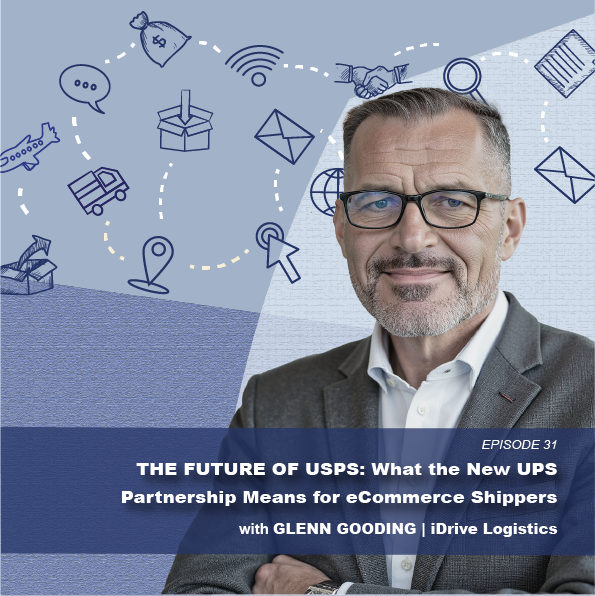
The Future of USPS: What the New UPS Partnership Means for eCommerce Shippers
Most shippers have long treated USPS as a fallback, but that may be changing. In this episode, Glenn breaks down why a potential return to DDU access could reshuffle lightweight residential delivery. He explains how USPS’s past withdrawal fueled the rise of gig carriers, why Amazon’s quiet retreat from sub-1-lb parcels matters, and what all of this means for shippers navigating shrinking margins.


Lightweight residential shipping is growing fast and margins are tightening just as quickly. In this episode of Parcel Perspectives, host Glenn unpacks the forces reshaping the sub-1-lb landscape and why USPS, long considered a safety net for shippers, is suddenly back in the spotlight.
Glenn explains how USPS’s exit from Workshare and loss of DDU access set off a chain reaction: gig carriers moved in to fill the gap, delivery economics became strained, and even Amazon quietly stepped back from handling the lightest parcels. Now, with a tentative USPS–UPS agreement potentially restoring DDU access, the dynamics of the last mile may be shifting yet again.
Listeners will learn:
• Why DDU access alters the economics of lightweight delivery
• How USPS’s posture affects gig-carrier viability
• What Amazon’s retreat signals about the true cost of sub-1-lb parcels
• Where shippers should build resilience amid rising volatility
• How USPS’s network design—used differently—could offer real stability
Grounded, data-driven, and forward-looking, this episode offers much-needed clarity for shippers who are rethinking lightweight strategy and preparing for a more rational, more competitive last-mile market.
[00:00:00] It had a massive impact to UPS. They went overnight from being able to induct at the DDU level, the local Post Office level, to having to deliver everything final-mile with their Teamster drivers, the most expensive network in the US on that front. It really opened up what I believe is kind of a new and growing marketplace, the gig economy type of solution.
[00:00:31] I’m not here to tell you that the gig economy solution didn’t exist prior to that, but it really was an accelerant.
[00:00:39] Welcome to Parcel Perspectives, the podcast dedicated to small parcel shippers. I’m Glenn Gooding. In each episode, we dive into insights, best practices, and strategies to help you navigate this complex and costly market.
[00:00:53] Welcome to Parcel Perspectives. I’m your host, Glenn Gooding. The USPS is at a crossroads with new funding pressures, evolving delivery models, and modernization efforts underway. The postal service of tomorrow could look very different from what shippers rely on today. In this episode, we will unpack what is changing and how it affects small parcel strategy and what you can do now to stay ahead of the curve.
[00:01:23] A lot to unpack, folks. I’m glad you’re with me. I want to talk a bit about the state of the USPS today, and then, we will push into the implications in the marketplace, as well as maybe some more recent, let’s say, partnership changes and some things that are happening out there. I think we are going to find ourselves straying into the broader lightweight residential eCommerce market and all the players involved.
[00:01:55] So, end of the day here, end of this podcast, I hope to give you some real visibility to my perception of the direction the market is leading and how it might affect your sourcing strategy, your procurement strategy in the future to set yourself up for growth, success, and stability in this ever-changing market.
[00:02:20] For those of you who have listened to me in the past, and those of you who kick around in the small parcel market a lot, you are very aware of what is called the “Delivering for America Plan” that the postal service instituted—really, Louis DeJoy, the previous postmaster general— that “Delivering for America Plan” was a 10-year plan, started in 2021 to go through 2031, and it is meant to address legacy costs, notably, pre-funded retiree health benefits mandated by Congress, declining mail volumes, and aging infrastructure. The essence of that plan is a $40 billion investment in capital improvements like facility upgrades and fleet modernization, supporting policies to repeal or reduce the retiree pre-funding mandate, which is a massive millstone for the USPS.
[00:03:21] It previously cost the USPS over $5 billion annually. The introduction and refining of service standards—for example, slower delivery speeds for some services to reduce transportation expenses and improve plant productivity. Additionally, maintaining universal six-day mail and expanding seven-day package delivery to tap eCommerce opportunities.
[00:04:10] Now, to level set with everyone: The USPS projects $82.9 billion in revenue for fiscal year 2025. That is primarily derived from postage sales, shipping, and package services like Priority Mail and Ground Advantage. Now, I think it is important to note that the USPS’s funding is primarily from the sales of postage and shipping services.
[00:04:20] It does not rely on direct taxpayer funding for its core operations, although there are government appropriations that exist for certain programs like health benefits. Now, I think it is also noteworthy that everybody understands that they are operating at a significant loss—they have for a long time.
[00:04:42] It is forecast that in that same fiscal year, 2025, we are going to achieve about $6.9 billion in losses for the post office. So, significant headwinds on that front. I want to pull back on the rudder for a minute, and I want to get up to 30,000 feet and just share a perspective of, let us say, the broader eCommerce market as it pertains to small parcel.
[00:05:13] Should be no surprise to anyone. I have been very consistent on this position, but I want everyone to understand that the lightweight residential delivery is a challenge in this marketplace. It is not carrier-specific. I’m not talking solely about UPS or solely about FedEx or the USPS or OnTrac or GLS or a gig economy. It is a challenge.
[00:05:40] It is. And I will explain some of that for you. One, it is the most expensive delivery you have to do: fewer stops per mile typically, fewer packages per delivery stop, and lower revenue per delivery stop, because it is traditionally lighter weight and single piece. And so, you have to cover fixed expense with that dynamic. And that is a real challenge.
[00:06:07] I don’t care who you are. Now, that happens to be the area of growth as well. So, we all know that eCommerce is growing at double-digit speed year over year, and it is getting a more pronounced slice of the overall retail sector revenue on a year-over-year basis. That is where things are going for all the right reasons and convenience from a consumer perspective.
[00:06:39] Now, if we go back 10 months to Louis DeJoy, he was beginning to implement some more of the draconian type of changes for this Delivering for America. He took a, let us say, a dim view toward the Workshare program—Workshare program being postal aggregators and consolidators that would induct to the post office and leverage them solely for final-mile delivery. That affected the likes of UPSMI, UPS small parcel with their SurePost product at the time; could be DHL eCommerce; could be OSM. Pitney Bowes got hurt by that and pulled out of that market. But that is the market I am talking about.
[00:07:33] And so, over the evolution of slowing down first class, building out a ground network, and Louis DeJoy then looked at that and said, “I have an underutilized Ground hub-and-spoke network. I need to fill it up with parcels. Why am I accepting all these packages at the final mile? Let us collect more revenue. Let us source directly with the brands, and let us handle that product from pickup to delivery through a traditional lifecycle. And let us offset the operational expense of the investment of the ground infrastructure to move first-class mail.”
[00:08:10] I did not happen to necessarily agree with that, but I understand the logic behind that maneuver. What that did is turn the lightweight residential market on its backside back in January of this year—literally late December of last year. It forced DHL eCommerce to change its business model a bit and you will notice that they do not focus directly on less-than-a-pound volume. They really want the one-pound-and-up business at this point. It had a massive impact to UPS. They went overnight from being able to induct at the DDU level—the local post office level—to having to deliver everything final mile with their Teamster drivers.
[00:09:02] The most expensive network really in the US on that front. It really opened up what I believe is kind of a new and growing marketplace, the gig economy type of solution. I am not here to tell you that the gig economy solution did not exist prior to that, but it really was an accelerant for that.
[00:09:30] And so, you saw gig economy providers, driven by technology apps, go out and make very aggressive offerings in the marketplace to go out and snatch up that volume. I saw very aggressive rates, sub-$4 rates—more on that in a minute—and really grabbed and gobbled up a lot of business. UPS, as an example with their strain, had to realign their ground SurePost offering. They rebranded it to Ground Saver appropriately, and they had to impose rate increases on that rate structure to try to mitigate the cost increases that were [incurred] by having to make the final-mile delivery.
[00:10:19] As a result, if you follow UPS’s quarterly earnings reports, their volume on a year-over-year basis is down, driven predominantly off of a drawdown of Amazon as well as loss in that particular modality, right?
[00:10:33] So, those were all challenges. Now, I am of the opinion—you call me old fashioned—but I do not think a $4 lightweight residential rate is sustainable in the marketplace. For all of you who have them, great. High-five, you. Take it while you can, but I do not believe it is sustainable. And that is where we are going to circle back to the USPS as a player here.
[00:11:00] My personal opinion on that front is I believe there is a lot of private equity money, there is a lot of venture capital money that is looking for ways to penetrate this supply chain market. It is growing. It is growing rapidly at double-digit pace. And if you can invest in technology—that they love to invest in—that’s “sexy.”
[00:11:21] They want to go out and they want to expand in that marketplace. And that is what I believe you are seeing with the gig economy market: top-line revenue, “Hey, we will figure it out.” And everyone that might be a little new to the space might take the bait and think you can move to profitability through additional volume.
[00:11:43] I am here to tell you—I have run the simulations myself in my illustrious career—there is no pot of gold at the end of the rainbow in a lightweight residential market. I don’t care if you’re handling 10,000 pieces a day or you’re handling 10 million pieces a day; there is no pot of gold at the end of the rainbow there. So, I believe that there’s going to have to be some rationality pushed into that.
[00:12:10] Now, let’s go back to the USPS for a minute. The USPS is uniquely positioned to service the lightweight residential market like no other. They can own the market if they choose to. They have the asset-based infrastructure. They go to every delivery address six days a week, and they have the added benefit of having the most efficient residential delivery being that: if it fits in the mailbox, they do not get out of the vehicle. They just push it in with the rest of the first-class mail that goes, and they are on their way. No other carrier is afforded that benefit. So, there’s something to consider if you are a procurer of these things.
[00:13:02] Now, we talked—I talked a lot about Delivering for America. It is still in place, but we have a new postmaster general, General David Steiner. It is not entirely clear what his position is with regard to Workshare programs and induction. However, UPS announced, I believe a day after their quarterly earnings, that they are entering into a tentative agreement with the post office to once again induct volume at the DDU level or into the post office for final-mile delivery.
[00:13:44] That, to me, seems to be a bellwether for change in the strategy that the USPS has around the eCommerce residential marketplace. It’s a huge benefit for UPS. It relieves them of a tremendous cost burden on delivering final mile. It allows them to flex their technology to induct to the postal service where it makes sense, when it makes sense, with Ground Saver product, and I believe it will allow them to be more competitive in that space again and stave off the volume loss in that modality.
[00:14:24] I do not know the details. I am on the sidelines just like you are, but I also believe that it will have direct benefit for UPS Mail Innovations. Now, I would expect that is a bellwether for a softening position overall, so that the OSMs and DHL eCommerces [are] already aligned with the post office, but I believe it has a marked impact to the gig economy. I think it’s going to put an increased strain because it’s going to allow other non–gig economy type carriers to begin to compete again in that space.
[00:15:09] So, as you as a procurer think about that—and if you are one of the real sophisticated ones out there that are using some of these gig economy providers—and some claim to do a very, very nice job—I believe the music will stop playing at some point. You are going to see massive consolidation in that point. You are going to see rationalization. You are going to see things happen.
[00:15:38] To further underscore my point on this, to try to give you some validation of my opinion: you have got another major small parcel carrier out there called Amazon Logistics. When this first happened, they went out with, in some cases, an aggressive less-than-a-pound rate and very quickly realized just what I have stated to you: that the lightweight residential delivery is a cost burden.
[00:16:05] And so, what they have done in the meantime is try to rationalize that. They have attempted to raise those rates, in some cases cancel that offering to some of their clients, or throttle—limit the amount of lightweight volume they get. So, for example, if you are in an Amazon Logistics agreement, it’s possible that they limit the percentage of volume that falls under one pound. You can get these rates, but you cannot exceed 20% usage of less than a pound, as an example. So, a lot happening on that side. I think it is a smart move for the post office, and I think it positions the post office to grow and grow profitably in the eCommerce environment.
[00:16:54] I want you to think about the postal service. They’re already stopping at every mailbox six days a week. They already have the fixed expense. They already have the vehicles. Those vehicles are not as large as an Amazon delivery vehicle or a UPS delivery vehicle or a FedEx delivery vehicle. So, they don’t want the big stuff.
[00:17:21] The national legacy carriers like UPS and FedEx are still going to be competitive, and I still think control the day in that market. But UPS, for example, is now strategically positioned to compete more aggressively in that lightweight space and tender that business to the carrier that does it and, in my opinion, does it best.
[00:17:47] They are already at the mailbox, and all we are doing is adding revenue into that already existing fixed expense. So, there is a massive ripple effect that I think is going to go back through the marketplace in 2026 here. I believe you are going to begin to start seeing some rationalization with the lightweight pricing that you see in the marketplace.
[00:18:15] I think it’s highly possible you are going to see more consolidation with some of the gig economy providers. When you talk about a gig economy carrier, realize they have very little assets, and so, if the music stops playing and they’re out of money and they’re no longer receiving funding, how long do you think it might take for them to shutter?
[00:18:38] Consider that with your resiliency. The takeaway out of this, in my opinion, is you need to have the USPS as part of your eCommerce strategy. They must be a valuable part. They will service the rural and super-rural areas very effectively for you. Gig economy providers don’t. And now, with the recently announced tentative partnership with UPS, you can also utilize the post office indirectly through an enhanced partnership with UPS on that front.
[00:19:21] So, keep your ear to the ground on this, and I very much appreciate the cost-savings allure of the gig economy. I’m not telling you not to do it, but I am telling you you need to have a viable contingency plan. You need to build resiliency in your eCommerce program on that front, and in all cases, if you are an eCommerce shipper, the USPS has a valuable place for your company and for your customers on that front.
[00:19:56] So, thank you once again for listening to me on another episode of Parcel Perspectives. By all means, feel free to reach out, and please, if you like what you’re hearing, send it to a friend. Would love to expand the audience. Thank you very much.
[00:20:22] Thanks for listening to Parcel Perspectives hosted by me Glenn Gooding. I’ve been in the small parcel space for 37 years, starting with a deep and broad background, working for one of the major carriers as an operator and industrial engineer later managing pricing at the highest level for the largest, most complex shippers in the world.
[00:20:41] Since then, I’ve been a national thought leader and worked to help drive strategy for clients from Fortune 50 companies to start up eCommerce businesses, helping them more competitively align in this complex and expensive market. If you enjoyed the show, please subscribe and share with friends. Join us next time for more expert advice and strategies to stay ahead of the shipping game.
Key Topics with Timestamps
- 1:26 The 'Delivering for America' plan and USPS’s financial reality
- 4:47 Why lightweight residential delivery strains every carrier
- 5:46 How USPS’s Workshare shift disrupted lightweight parcel flows
- 8:09 The rise of gig-economy carriers and sub-$4 pricing
- 11:16 Why USPS is uniquely positioned for lightweight delivery
- 12:50 UPS–USPS tentative DDU agreement and what it signals
- 13:30 Competitive pressure and gig-economy vulnerability
- 15:11 Amazon’s recalibration on sub-1-lb parcels
- 17:44 Resiliency, contingency planning, and USPS’s essential role
Other Podcasts
-
10
Jan 22, 2025
A Consultant’s Role in Supply Chain & Carrier Contracts
Discover how logistics consultancy revolutionized small parcel shipping for Right Manufacturing Systems in this episode of Parcel Perspectives. Join Glenn Gooding and Ian Hartman as they discuss achieving a 23% reduction in shipping costs, leveraging data for smarter decisions, and the invaluable insights gained from expert consultancy. Tune in to learn how deep industry knowledge and strategic negotiations can transform your logistics operations.
-
9
Nov 13, 2024
How Reverse Logistics Shapes Holiday eCommerce
Join Glenn Gooding and Cathy Roberson as they dive into the world of reverse logistics. Discover how carriers like UPS, FedEx, and USPS are adapting to the growing returns trend, and explore innovative strategies for handling oversized items and complex returns. Learn about the latest trends, including "bracketing" and sustainable practices, and how AI is transforming the returns process.
-
15
Feb 19, 2025
Future Vision: Key Supply Chain Investments for the Next Decade
The Future of Logistics is Here. Join Glenn Gooding and special guest Benjamin Gordon, Managing Partner and CEO at Cambridge Capital, in this week's episode of Parcel Perspectives as they explore the cutting edge of supply chain management. This episode covers it all: the AI revolution, the eCommerce explosion, the crucial role of customer experience, and the growing importance of sustainability. Get expert insights into future investment opportunities and discover how to build a resilient supply chain that can withstand any disruption. Tune in and future-proof your business!